

How to Keep a Trading Journal and Review It With AI: We Tested ChatGPT and Claude on 398 Trades
· Updated
Short answer: a trading journal is a record of every trade with its result, size, costs and the reason you took it. Export your trades once a week, add what the export cannot know, calculate six numbers and look for one habit to change. AI can do the arithmetic and spot patterns: in our test, ChatGPT found all six mistakes we planted in a 398-trade log when given a detailed prompt, and four of them when asked a simple question. The models also listed problems in a log where we had planted none, so treat every finding as something to test, not as a verdict.
This guide is for traders in any market: stocks, forex, futures or crypto. It covers what to log, which numbers matter and how to export your history. It also shows what we saw when we gave the same test file to ChatGPT and Claude, and the exact prompt we used.
How do you keep a trading journal?
Keep it in one place, fill it from your platform's export, and review it on a fixed day. A spreadsheet is enough. The routine takes five steps:
- Choose one place. A spreadsheet, a journal app or a notebook all work. What matters is that every trade goes in the same place.
- Export your trades once a week. Most platforms give you a file with times, prices, size and fees, so you do not need to type them.
- Add four things by hand. Your planned risk, the reason for the trade, whether you followed your plan, and your state of mind in one word. Write them when you open the trade, because memory rewrites them later.
- Review on a fixed day. Calculate the six numbers below, then look for one pattern.
- Change one thing. Test it on your next 50 to 100 trades before you change anything else.
A fixed review day has a practical reason. In a classic experiment, people who checked their results more often took less risk (Gneezy and Potters, 1997), although later studies are mixed. Watching your results all day invites reactions to noise.
What should a trading journal include?
A trading journal should include what your platform records automatically and what only you know. The first part tells you what happened. The second part tells you why.
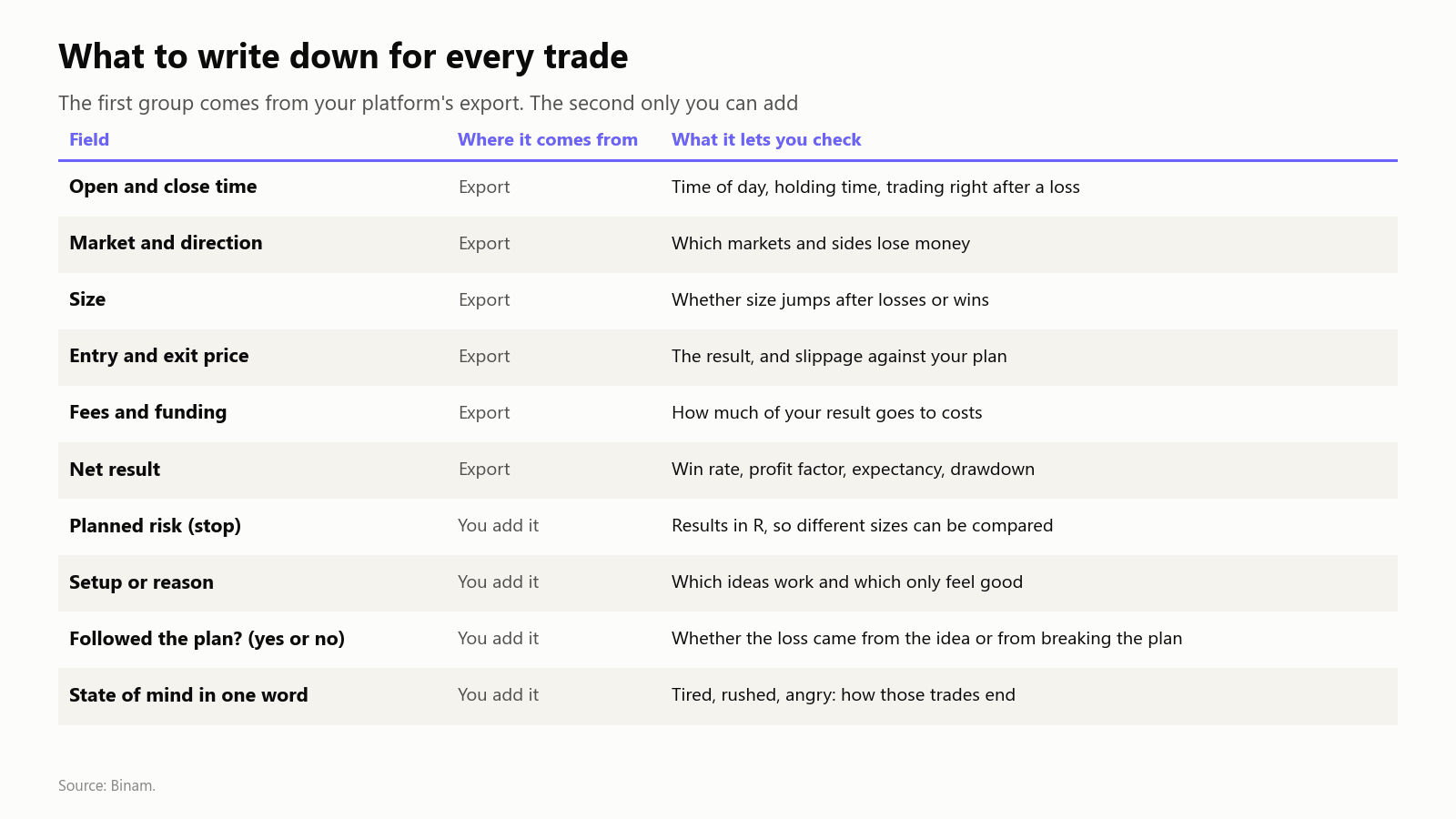
Use your trade or fill history, not your order history where you have the choice. Partial fills and fees are recorded at the level of fills, and those are the details a review needs.
If your platform records it, also keep the furthest a trade went against you and in your favour. These are called maximum adverse excursion and maximum favorable excursion (MAE and MFE), and MetaTrader 5 shows both in its trading report. They show whether your stops are too tight and whether you leave profit on the table.
Which trading journal numbers should you calculate?
Calculate win rate, average win and loss, profit factor, expectancy, maximum drawdown and, if you record your planned risk, R multiple. Together they show whether your results add up. Here they are with the result for our test log, whose trader was losing money.
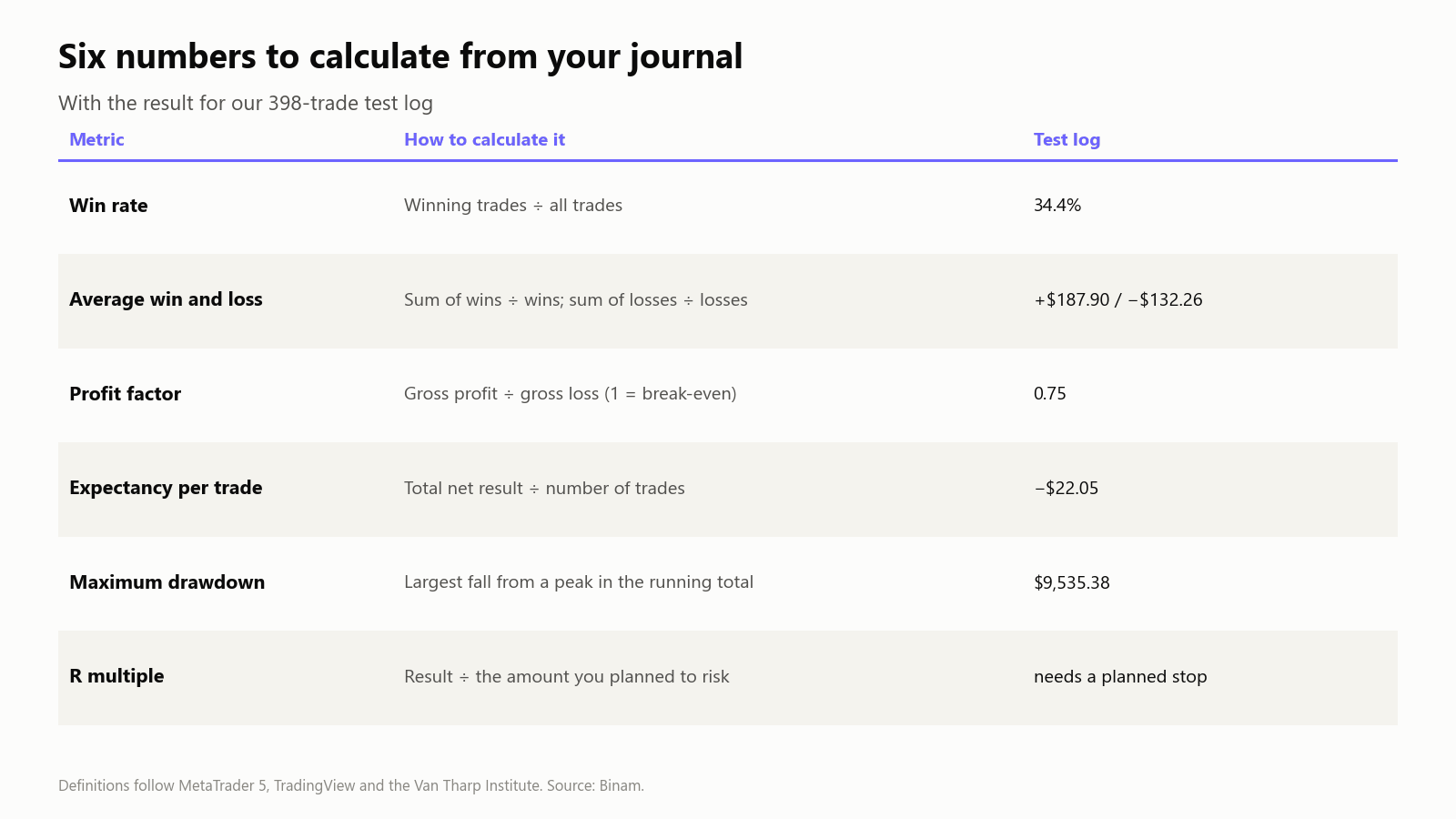
Win rate alone says little. The break-even win rate is the average loss divided by the sum of the average win and average loss. For the test trader that is 132.26 ÷ (187.90 + 132.26) = 41.3%, against an actual win rate of 34.4%.
R multiple is the result divided by the amount you planned to risk, so a $300 profit on a $100 risk is 3R. It lets you compare trades of different sizes (Van Tharp Institute). Your platform cannot calculate it unless you record a planned stop, which is why that column is worth filling by hand.
Include costs. In India's regulator data for the year to March 2026, 82.1% of individual derivatives traders lost money before costs and 87.7% after them (SEBI, August 2026). If you trade perpetual futures, count funding as a cost too; here is what funding really costs.
Does keeping a trading journal improve your results?
Nobody has proved that it does. We looked for a study that assigns traders to keep a journal and measures their results, and found none. What the evidence supports is narrower: a journal fixes a measurement problem.
- People do not know their own results. In a survey of 215 online-broker investors, the correlation between the returns they estimated and the returns they actually made was -0.07. Fewer than 5% thought they had lost money, while more than 25% had (Glaser and Weber, 2007, as summarized by CXO Advisory).
- Experience alone does not fix it. Among Indian derivatives traders, the share of loss-makers rose from about 91% in the first year to over 95% after four or more consecutive years (SEBI, August 2026). A study of Brazilian day traders found no evidence of learning (Chague and co-authors, 2019).
- Removing a bias is not the same as making money. In the closest experiment we found, a feedback-style message reduced people's tendency to sell winners and keep losers, but returns did not improve, and at two weeks they were lower (Huang and Guenther, 2024).
So keep a journal to see what you actually do. Whether you can change it, and whether the change pays, is something your own next trades have to show.
Can ChatGPT or Claude analyse your trading journal?
Yes, for the arithmetic, and partly for the habits. To measure it we built a test log of 398 invented trades across stocks, forex, futures and crypto, and planted six mistakes in it. Then we calculated the correct answers in code and gave the file to the AI models.
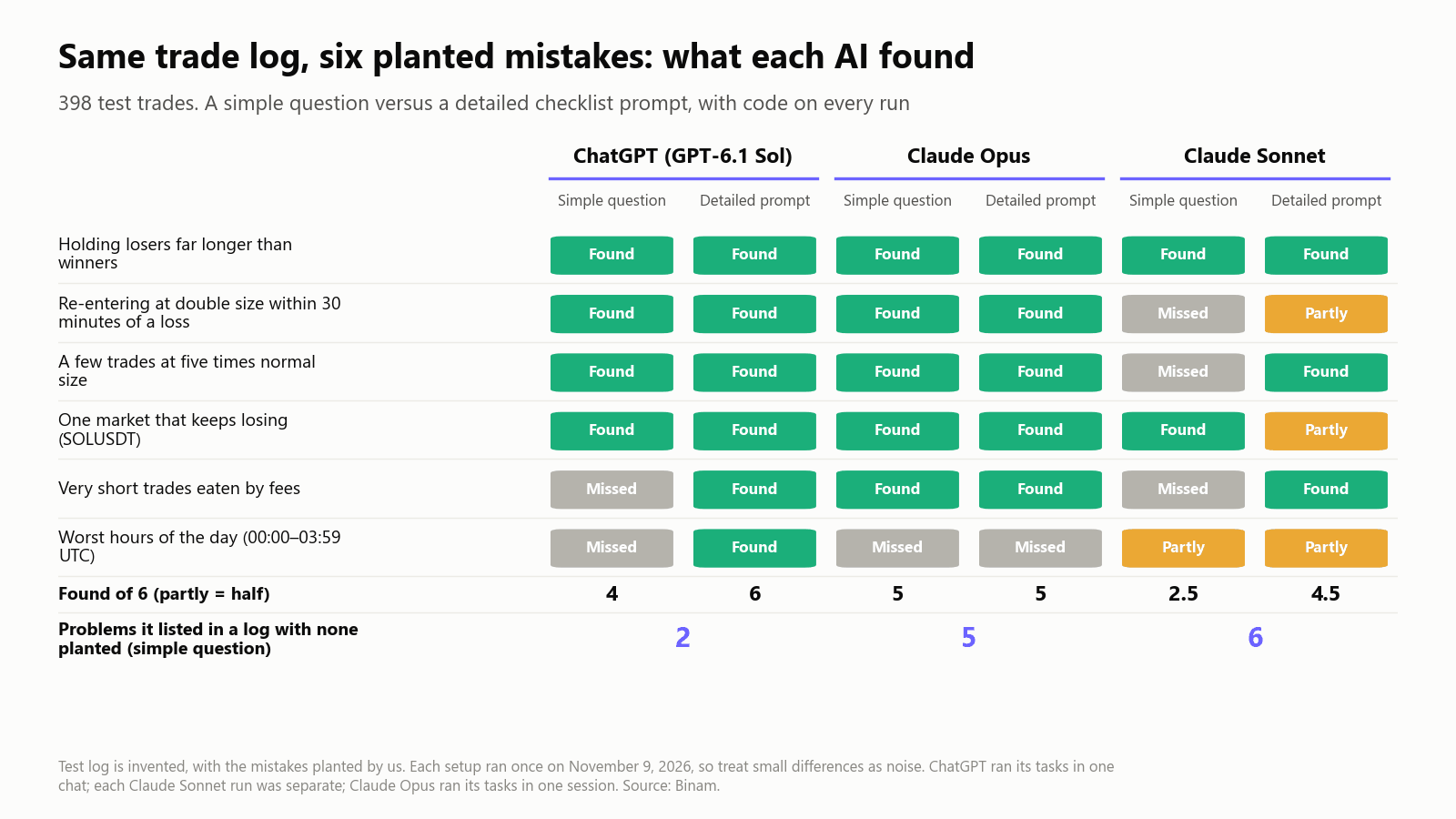
The planted habits were not subtle once the trades were split the right way:
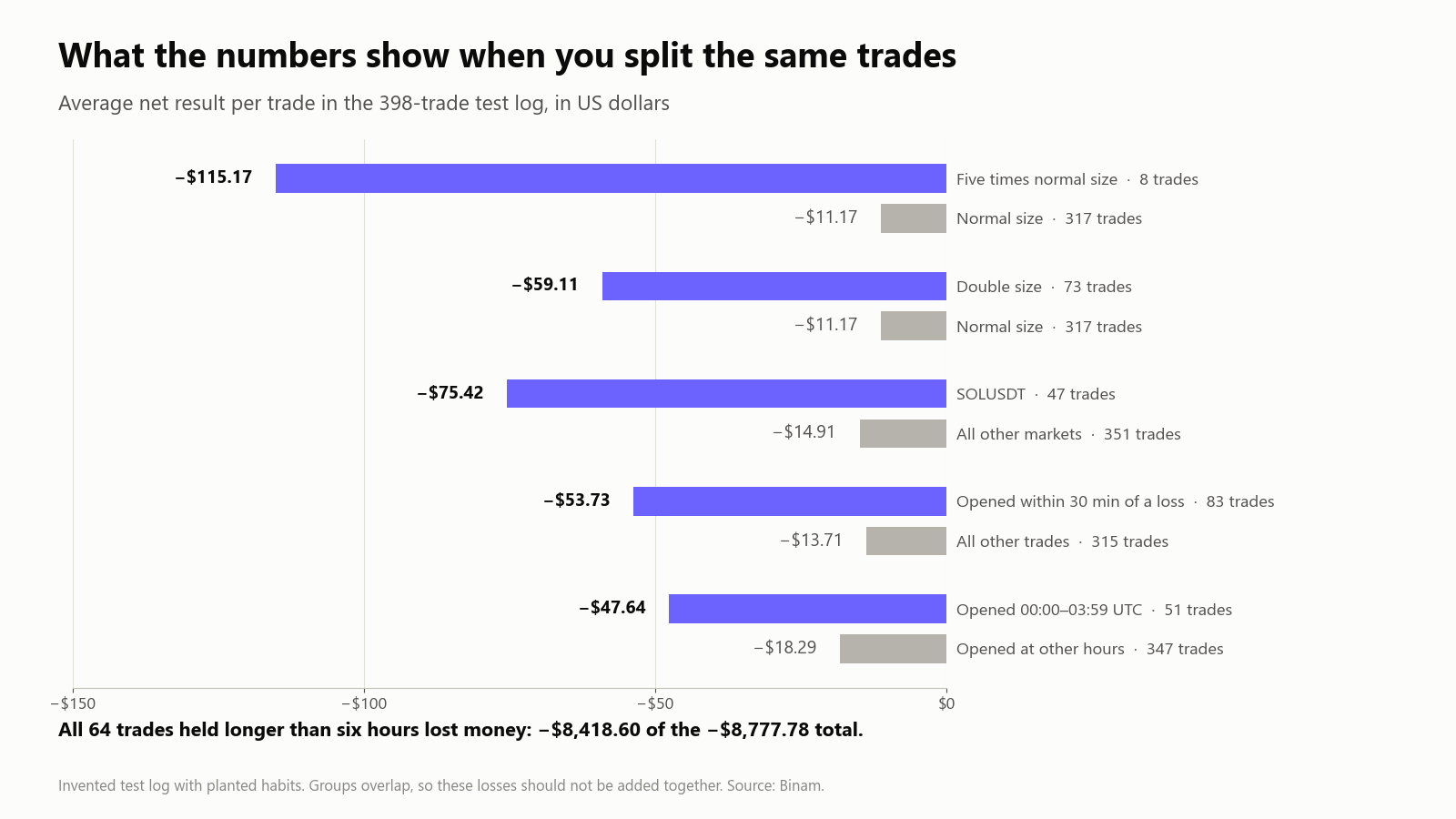
What we saw:
- The totals were right. Every run that used code reported the number of trades, net result, fees, win rate, profit factor and drawdown correctly.
- The question changed the answer. ChatGPT found four of the six mistakes with a simple question and all six with the detailed prompt. Claude Sonnet went from two and a half to four and a half. Claude Opus found five either way.
- The most dangerous error was false reassurance. Asked the simple question, Claude Sonnet said the trader did not size up after losses and that position size had no clear link to results. In fact 73 double-size trades, nearly all opened within 30 minutes of a loss, made up 49% of the total loss.
- Time of day was the hardest. Only ChatGPT's detailed run named the bad night hours outright. Claude Opus tested the hours and put the differences down to chance.
- Chance got blamed too. Claude Sonnet's simple answer pointed to bad Thursdays and weak short trades. Neither was planted; they appeared by luck.
- One model questioned the data. Claude Opus noticed that stocks and forex had trades at weekends and that prices jumped too far between trades, and suggested checking the export. The file is invented, so it was right to ask.
We also asked Claude Sonnet for the same figures without code. It got the totals right, but it took about six minutes instead of about one, and it checked holding times on only 60 of the 398 trades.
These are single runs on one invented file, so small differences between models mean little. Scores also change with the model version and settings. Harder analysis is a different matter: in one benchmark of real financial data tasks, the best baseline agent solved 14.55% of the hard ones (DABstep, 2025).
What prompt should you use to review your trades?
Use a prompt that makes the model run code, names the things to check and asks what could be chance. This is the prompt that found the most, plus one line we added afterwards so you can check that the model read the whole file:
Attached is my trade history as a CSV. Times are UTC. P&L is in USD and already net of fees.

Analyse it by running code on every row. Do not estimate.

First tell me the number of rows, the first and last dates, and the total net P&L, so I can check you read the whole file.

Then give me: number of trades, total net P&L, total fees paid, win rate, average win and average loss, profit factor, expectancy per trade, maximum drawdown in USD from the running total of net P&L ordered by close time, and net P&L for each symbol.

Then list the behavioural mistakes you can find, at most six. For each one, give the numbers behind it and compare those trades with the rest. Look at time of day, what happens just after a losing trade, how long I hold winners versus losers, position size, and very short trades.

Finally, tell me which patterns could just be chance because the sample is small.
Before you trust the answer, compare the row count, the dates and the total with your platform's own figures. If they differ, stop there. OpenAI itself tells users to review the code, outputs and assumptions of its data analysis (OpenAI Help).
Will AI find mistakes that are not there?
Yes. We ran a second file with 398 invented trades and no planted mistakes, and asked each model the simple question. All of them got the totals right. ChatGPT listed two problems, the midday hours and ETHUSDT, with caveats. Claude Opus listed five weak spots, but said it could not find a serious behavioural mistake and that several might be chance. Claude Sonnet listed six under "biggest mistakes" and advised restricting short trades in ETH and testing a break from the midday hours.
In a log this size, some hour, weekday or market will always look bad by chance. That is why the test that matters comes after the review. Take one finding, write down what you will change, and check it on trades the AI has not seen. If the pattern disappears, it was probably noise.
How do you export your trade history?
Most platforms let you export your history as a file. Menus change, so check the current help page:
- Binance: Profile icon, Orders, Spot Order, Trade History, Export Trade History. One statement covers up to one year (Binance). Futures have a separate export in the Orders section (Binance).
- Bybit: Profile, Account, Data Export, on the web. One year per file (Bybit).
- OKX: Assets, Order center, Trading history, Download (OKX).
- MetaTrader 4: right-click the Account History tab, choose the period, then Save as Report. The file is HTML (MetaTrader 4).
- MetaTrader 5: History tab, context menu, Report (MetaTrader 5).
- TradingView: the Download data button in the trading panel; each tab exports separately as CSV (TradingView).
- Interactive Brokers: Flex Queries under Performance & Reports, with CSV as one of the formats (IBKR).
If your history spans several files, merge them and remove duplicates before you analyse them.
Is it safe to upload your trades to an AI?
Uploading a file is safer than connecting your account, but it is not private by default. An exported file cannot place orders or move money, while an API key with trading rights can place orders. We covered those risks in our guide to connecting AI to exchanges. For a review of past trades you do not need a connection at all.
Before you upload:
- Remove anything that identifies you: account numbers, names, wallet addresses and order IDs you do not need.
- Check the training setting. ChatGPT, Claude and Gemini can all use consumer chats to train models unless you turn this off (OpenAI, Anthropic, Google).
- Remember that opting out is not deletion. ChatGPT's temporary chats may be kept for up to 30 days (OpenAI), and Gemini keeps temporary chats for 72 hours (Google).
Do you need a journal app, a spreadsheet or AI?
Start with a spreadsheet. It is free, it holds every column above, and you can see every formula. A journal app is worth paying for if you want automatic import, charts and tags without building them. AI is a way of asking questions about the data, and it works on a file from either one. You do not have to choose between them.
Frequently asked questions
How do I start a trading journal?
Export your last three months of trades from your platform into a spreadsheet. Add a column for planned risk, the reason for the trade, whether you followed your plan, and your state of mind. Fill those in for every new trade and review the sheet once a week.
How often should I review my trading journal?
Once a week is a sensible default for active traders, with a longer review each month or quarter. Fill in the journal after each trade, but draw conclusions only on a schedule, so you are not reacting to the last few results.
How many trades do I need before I can trust a pattern?
There is no fixed number, and the more you split your trades, the less each group means. As a working rule, treat a group of fewer than about 30 trades as a question rather than an answer, and confirm any pattern on trades that came later.
Can ChatGPT read a CSV of my trades?
Yes. It can run Python on a CSV you attach, up to about 50 MB depending on row size (OpenAI). In our test it calculated every total correctly. Ask it to use code and compare the row count and total with your platform's figures.
Is a 34% win rate bad?
Not by itself. It depends on how much you win compared with how much you lose. With an average win twice the average loss, you break even at about 33%. The test trader's wins were only 1.4 times the losses, so a 34.4% win rate lost money.
Should I let AI decide my trades?
This article covers reviewing past trades, not choosing new ones. A review can show you what you did. It cannot tell you what the market will do next.
How we tested
We generated two logs of 398 invented trades from April to September 2026 in eight markets, using a fixed random seed. They are not anyone's real trades. In the first we planted six habits. In the second, every trade had the same odds whatever its time, market or size, so there was nothing real to find. We calculated the correct answers in code before running any model.
We ran each setup once on November 9, 2026: ChatGPT with GPT-6.1 Sol on high reasoning, in the desktop app with access to the files, and Claude Opus and Claude Sonnet through Claude Code. ChatGPT and Claude Opus each did their tasks one after another in one session. Claude Sonnet got each task separately. We scored a mistake as found if the model named it with correct numbers, and as partly found if it mentioned the pattern but dismissed it or described only part of it.
Where to start
Export your last three months of trades, remove your account details and run the prompt above. Pick the one finding that costs you the most, and test a change on your next 50 trades. If position size turns out to be the problem, start with how to size a position and how close your liquidation price really is.
Trading involves risk. This article is for information only and is not investment advice.