

Funding Rate Explained: How It's Calculated, Who Pays, and What 7 Years of BTC Data Show
· Updated
Short answer: the funding rate is a periodic payment between traders who hold a perpetual futures contract. It keeps the perpetual's price close to the spot price. When the rate is positive, longs pay shorts; when it is negative, shorts pay longs. The exchange keeps none of it. The default rate is 0.01% of position value per 8 hours, which adds up to about 10.95% a year.
Below you will find the formula with a worked example and the rules of five venues, followed by what funding cost traders in our own dataset: 102,230 payments on Binance and Bybit from 2023 to 2026, plus the full BTCUSDT history on Binance since September 2019.
What is the funding rate in crypto?
The funding rate is the percentage of position value that one side of a perpetual futures market pays the other at each funding time. A perpetual contract never expires, so no settlement date pulls its price to spot the way it does for a quarterly future. Funding does that job: when the perpetual trades above the spot index, longs pay to stay in and shorts get paid, which pushes the two prices together.
The payment for one position is simple:
Funding payment = position size × mark price × funding rate
Binance, Bybit, OKX and Bitget all use the mark price for the position value (Binance, Bitget). Hyperliquid uses the spot oracle price instead (Hyperliquid docs). A $10,000 position at 0.01% pays or receives $1.
Funding is charged on notional value, so leverage multiplies it against your own money: at 10x the same $1 is 0.1% of a $1,000 margin.
Who pays funding: longs or shorts?
With a positive funding rate, longs pay shorts. With a negative rate, shorts pay longs. Only traders who hold a position at the funding time pay or receive anything. Binance states that if you close before the funding time you "will not pay or receive any funding", with a 15-second deviation in the actual transfer time (Binance FAQ). OKX says the assessment may take up to a minute (OKX).
Binance says it "does not charge fees on Funding Payments", and OKX says it does not "collect or retain any portion of the funding fee". Exchanges still list the payment in your history as a funding fee, which is why many traders think of it as one.
Positive funding is the usual state. On Binance BTCUSDT, 85.7% of the 7,801 payments since September 2019 were positive, so longs paid most of the time.
How is the funding rate calculated?
Funding has two parts: a fixed interest component of 0.01% per 8 hours and a premium index that measures how far the perpetual trades from the spot index. Binance publishes the formula like this (source):
Funding Rate (F) = [P + clamp(I − P, −0.05%, +0.05%)] / (8 / N)

P = average premium index over the interval
I = interest rate, 0.01% per 8 hours (0.03% per day)
N = funding interval in hours (8, 4 or 1)
The clamp keeps the funding rate within 0.05% of the premium index. In practice, whenever the average premium sits between −0.04% and +0.06%, the funding rate equals exactly 0.01%. That is why 0.01% shows up so often on exchange screens: on BTCUSDT it was the exact rate in 27.1% of payments from January 2023 to October 2026, and in 43.1% of payments in 2021.
Binance samples the premium index every 5 seconds (5,760 points per 8 hours) and gives later points more weight; Bybit does the same once a minute (Bybit). The result is then clamped to the contract's cap and floor.
A worked example
Take a BTC perpetual with an 8-hour interval and a $10,000 position.
- Average premium P = +0.03%. Then I − P = 0.01% − 0.03% = −0.02%, inside the ±0.05% clamp. F = 0.03% − 0.02% = 0.01%. The long pays $1.00.
- Average premium P = +0.10%. Then I − P = −0.09%, which the clamp cuts to −0.05%. F = 0.10% − 0.05% = 0.05%. The long pays $5.00 per payment, $15 a day if the premium holds.
- Average premium P = −0.10%. Then I − P = +0.11%, clamped to +0.05%. F = −0.05%. Now the short pays the long $5.00.
- The same coin on a 4-hour interval (N = 4) with P = +0.10%: F = 0.05% / 2 = 0.025% per payment. There are six payments a day instead of three, so the daily cost is the same 0.15%.
The rate you see before the funding time is an estimate. Bybit says the rate "will fluctuate in real-time until the upcoming funding timestamp" and "is updated every minute". OKX charges the rate calculated in the minute before assessment: the 16:00 payment uses the 15:59 rate.
How do Binance, Bybit, OKX, Bitget and Hyperliquid differ?
All four large centralized exchanges use the same structure: 0.01% interest per 8 hours, a ±0.05% clamp and a per-contract cap. The details differ, especially the interval rules and how the payment reaches your balance. Hyperliquid, a decentralized exchange, pays every hour and caps funding at 4% per hour.
| Venue | Default interval | Interest part | Cap and floor | When the interval changes | Where funding shows up |
|---|---|---|---|---|---|
| Binance | 8h (00:00, 08:00, 16:00 UTC); most USDT perps now 4h | 0.01% per 8h; 0% on some pairs such as ETHBTC | ±0.75 × maintenance margin ratio on listed symbols (BTCUSDT ±0.3%); ±2% on other USDⓈ-M perps | To 1h after a settlement hits the cap or floor (since 2 May 2025); back to 4h after 16 hourly cycles in a row within ±0.025% (since 2 Jan 2026) | Taken from available futures balance, then from position margin, which can move the liquidation price |
| Bybit | 8h; many perps 4h | 0.03% per day scaled to the interval; 0% on pairs such as USDCUSDT | ±min((IMR − MMR) × 0.75, MMR) (BTCUSDT ±0.333%) | To 1h when a settlement hits the limit, "without separate announcements" | Not in unrealized P&L; deducted in realized and closed P&L |
| OKX | 8h; also 1h, 2h or 4h | 0.01%, with the whole rate divided by 8/N | Set per contract (BTC-USDT-SWAP ±0.375%) | One step faster (8, 4, 2, 1 hour) after hitting the cap; back to default after 12 hours of settlements within ±0.20% | From position margin (isolated) or account equity (cross); can trigger size reduction or liquidation |
| Bitget | 8h; some contracts 2h or 4h | Typically 0.01%, divided by 8/N | ±0.75 × maintenance margin rate by default (BTCUSDT ±0.3%) | Not described on the help page | The receiver may get less than the full amount if the payer is liquidated |
| Hyperliquid | Every hour | 0.00125% per hour (0.01% per 8h) | 4% per hour | Always hourly | Notional at the spot oracle price, not the mark price |
Sources: Binance FAQ (updated 6 Mar 2026), Bybit funding (22 May 2026) and Bybit P&L (12 Aug 2026), OKX, Bitget (22 Oct 2024), Hyperliquid. Interval shares and BTC caps come from the exchanges' public APIs on 23 October 2026. All pages checked on 23 October 2026.
Hyperliquid describes its interest part as "11.6% APR", while 0.01% × 3 × 365 gives 10.95%. The difference is compounding: 11.6% assumes the hourly payments are reinvested, and 10.95% is the simple sum.
What is the funding rate interval: 8, 4 or 1 hour?
The old rule of thumb, "funding is paid every 8 hours", no longer describes most contracts on Binance. Eight hours is still the documented default, and BTC and ETH still settle three times a day, but many altcoins pay every 4 hours and a contract can move to 1 hour automatically when its rate hits the cap.
Our snapshot of USDT perpetuals from the public APIs on 23 October 2026, 13:57 UTC:
| Exchange | USDT perps | Every 8h | Every 4h | Every 2h | Every 1h |
|---|---|---|---|---|---|
| Binance | 522 | 105 | 415 (80%) | 0 | 2 |
| Bybit | 808 | 425 | 379 (47%) | 0 | 4 |
| OKX | 508 | 292 | 213 (42%) | 3 | 0 |
| Bitget | 876 | 488 | 386 (44%) | 0 | 2 |
Counting USDC-margined contracts too, Binance had 432 of 565 perpetuals on a 4-hour schedule that day, or 76%. Hyperliquid pays every hour on every market.
In our ten-coin dataset, BTC, ETH, SOL, XRP, DOGE, PEPE and SUI settled every 8 hours on all four exchanges, and WIF, ORDI and TRB every 4 hours. Intervals also move: TRB on Bybit dropped to 2 hours on 1 January 2024, during a squeeze, and went back to 4 hours two days later.
A 4-hour rate looks half as large, but you pay it twice as often. Compare coins in 8-hour equivalents (rate × 8 / interval) or in annual terms, never by the raw number on the screen.
What does funding cost to hold a position?
Funding is small for a trade that lasts hours and becomes a real cost over weeks. We measured every real holding window on Binance from January 2023 to October 2026 for a $10,000 position held 1, 7 or 30 days, at a fixed size and without price moves or fees.
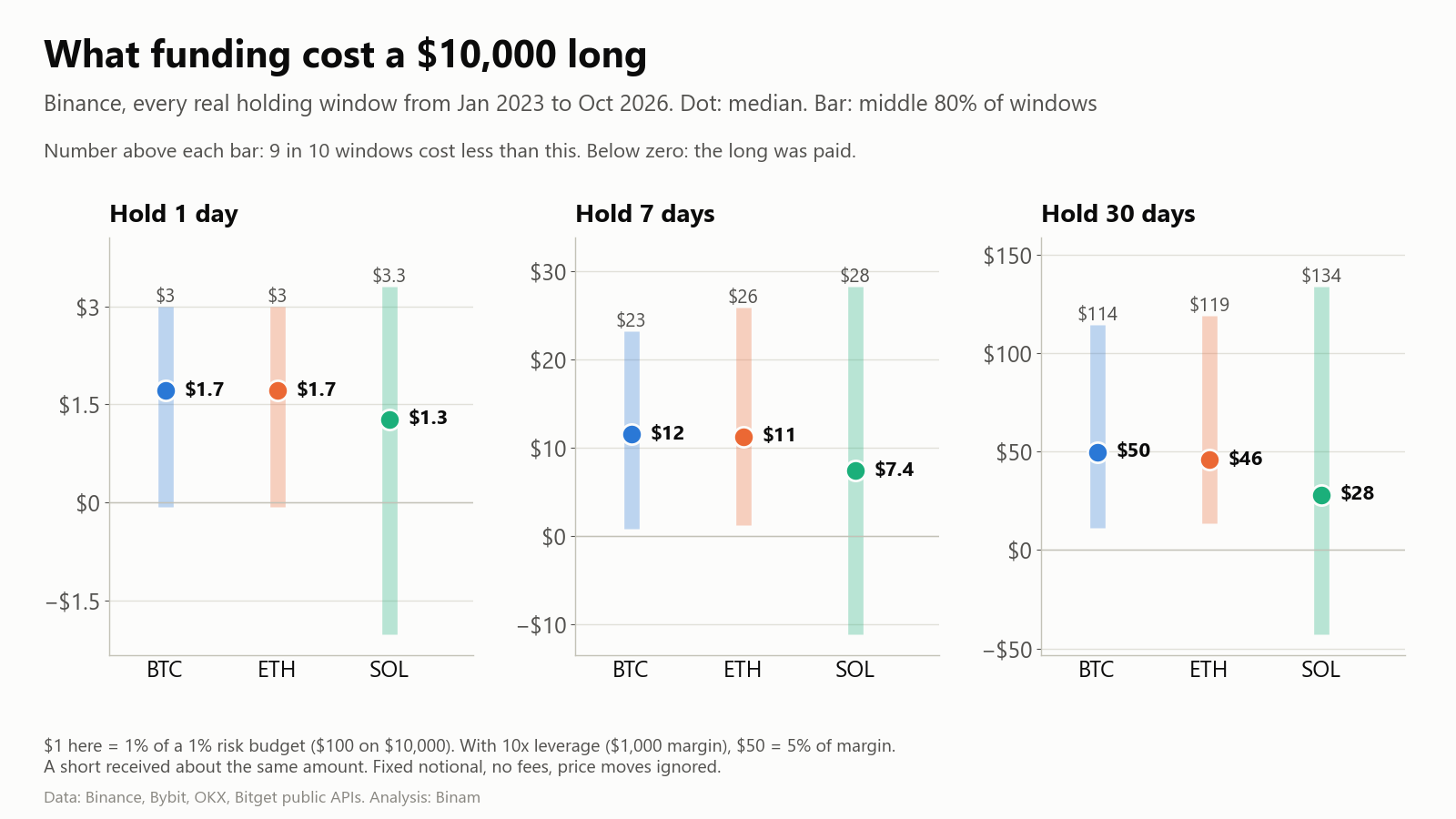
A $10,000 BTC long paid a median of $1.71 for one day, $11.52 for a week and $49.74 for 30 days. One 30-day window in ten cost more than $114.17, and the worst one cost $321.92. The long paid something in 89% of one-day windows and 93% of 30-day windows. A short received the mirror amounts.
Against margin, the same numbers look like this:
| BTC long, $10,000 | Median | 1 window in 10 cost more than |
|---|---|---|
| 7 days, 5x ($2,000 margin) | 0.58% of margin | 1.16% |
| 7 days, 10x ($1,000 margin) | 1.15% | 2.32% |
| 30 days, 5x | 2.5% | 5.7% |
| 30 days, 10x | 5.0% | 11.4% |
The worst 30-day window at 10x took 32.2% of margin. SOL was much less predictable: the 30-day median was $27.94, but the middle 80% of windows ran from a $42.78 credit to a $133.85 cost. A SOL short paid $385 in its worst week, in January 2023 after the FTX collapse, when funding reached −0.93% per 8 hours.
To check your own position, multiply three numbers: rate per payment × payments you will hold through × leverage. That gives the cost as a percentage of margin. At 0.01% per 8 hours and 10x, that is 0.3% of margin a day and about 9% over 30 days.
What does BTC funding rate history show from 2019 to 2026?
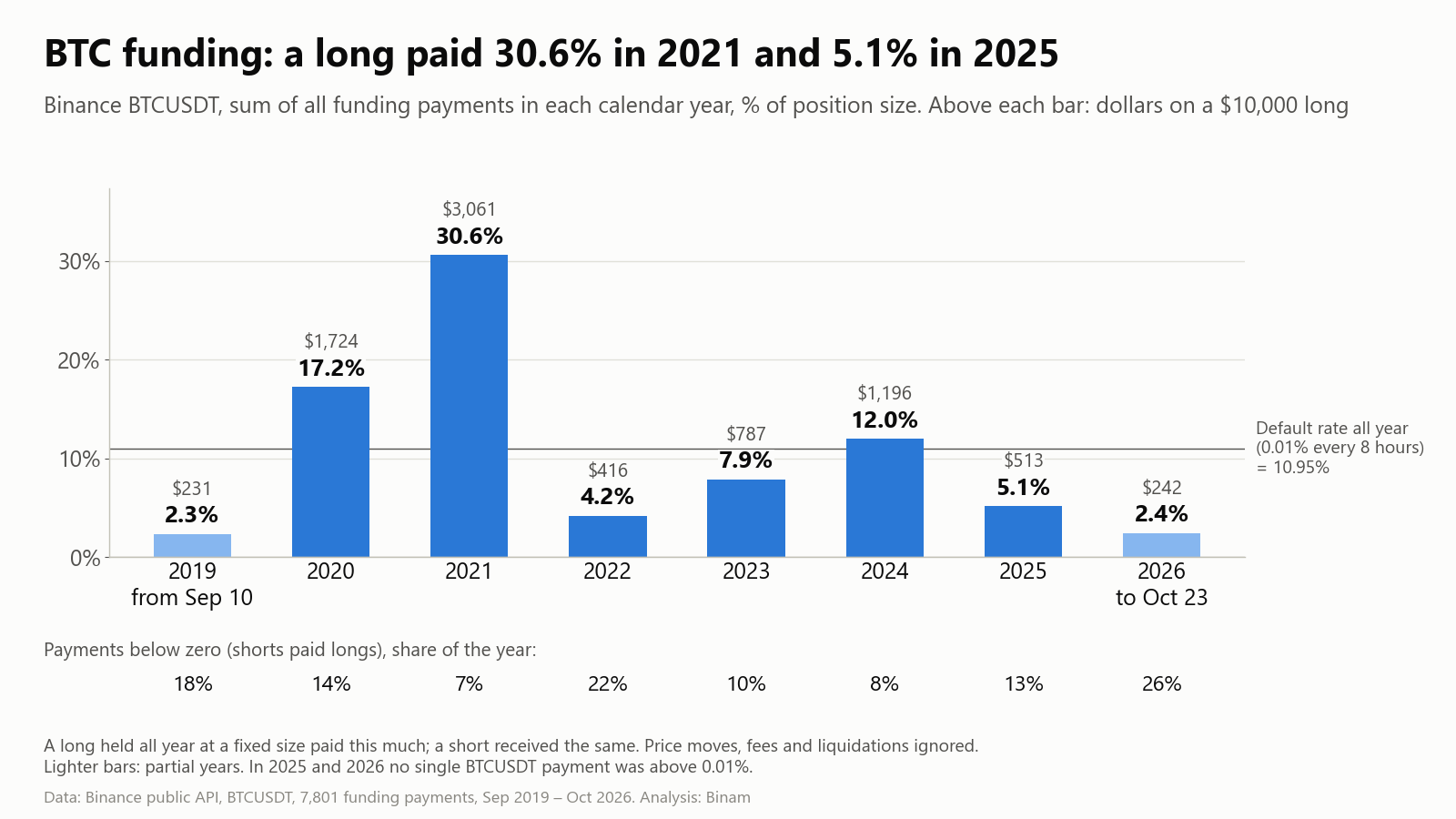
BTC funding was far higher in the 2020 and 2021 bull market than at any time since. A long that held BTCUSDT on Binance through all of 2021 paid 30.61% of its position value in funding. In 2025 the same position paid 5.13%, and from 1 January to 23 October 2026 it paid 2.42%.
| Year | Payments | Long paid over the year | On a $10,000 long | Payments below zero | Highest single payment |
|---|---|---|---|---|---|
| 2019 (from 10 Sep) | 338 | 2.31% | $231 | 18.3% | 0.0784% |
| 2020 | 1,098 | 17.24% | $1,724 | 14.3% | 0.30% |
| 2021 | 1,095 | 30.61% | $3,061 | 7.3% | 0.249% |
| 2022 | 1,095 | 4.16% | $416 | 22.1% | 0.01% |
| 2023 | 1,095 | 7.87% | $787 | 10.1% | 0.0552% |
| 2024 | 1,098 | 11.96% | $1,196 | 8.4% | 0.0881% |
| 2025 | 1,095 | 5.13% | $513 | 12.9% | 0.01% |
| 2026 (to 23 Oct) | 887 | 2.42% | $242 | 25.7% | 0.01% |
In 2025 and 2026 no single BTCUSDT payment was above 0.01%. Rates of 0.1% per period and higher, which older guides warn about, appeared on BTCUSDT only in 2020 and 2021; the worst 30-day stretch for a long was 7.72% of position value, in the window ending 27 February 2021. In February, March and April 2026 most payments were negative: 54%, 56% and 64% by month.
How we counted: the "long paid" column is the sum of all funding rates in the calendar year, taken from Binance's public funding history endpoint (GET /fapi/v1/fundingRate, symbol BTCUSDT). We downloaded all 7,801 payments from 10 September 2019 to 23 October 2026. ETH tells a similar story: a full-year ETH long paid 37.54% in 2021 and 4.93% in 2025.
What does a negative funding rate mean, and is it bullish?
A negative funding rate means the perpetual trades below the spot index and shorts pay longs, so it is a cost for anyone holding a short. It shows that demand to be short outweighs demand to be long at that price. It does not tell you what price will do next.
Negative funding has appeared in two very different situations. Sometimes it follows a crash that already happened: BTCUSDT hit −0.30% at 08:00 UTC on 13 March 2020 and −0.1192% on 10 November 2022 during the FTX collapse. Sometimes crowded shorts got squeezed: SOL in January 2023 paid down to −0.93% per 8 hours, and TRB in late 2023 reached −2% per 4 hours on Binance. Both kinds of episode start with the same negative number on the screen.
What happens to funding during a crash?
On the largest BTC contract, funding gave no warning before the crash of 10 October 2025, and the sharpest negative rates came after it, on altcoins. About $19 billion of positions were liquidated in a day, according to reports citing Coinglass data (KuCoin News, 21Shares).
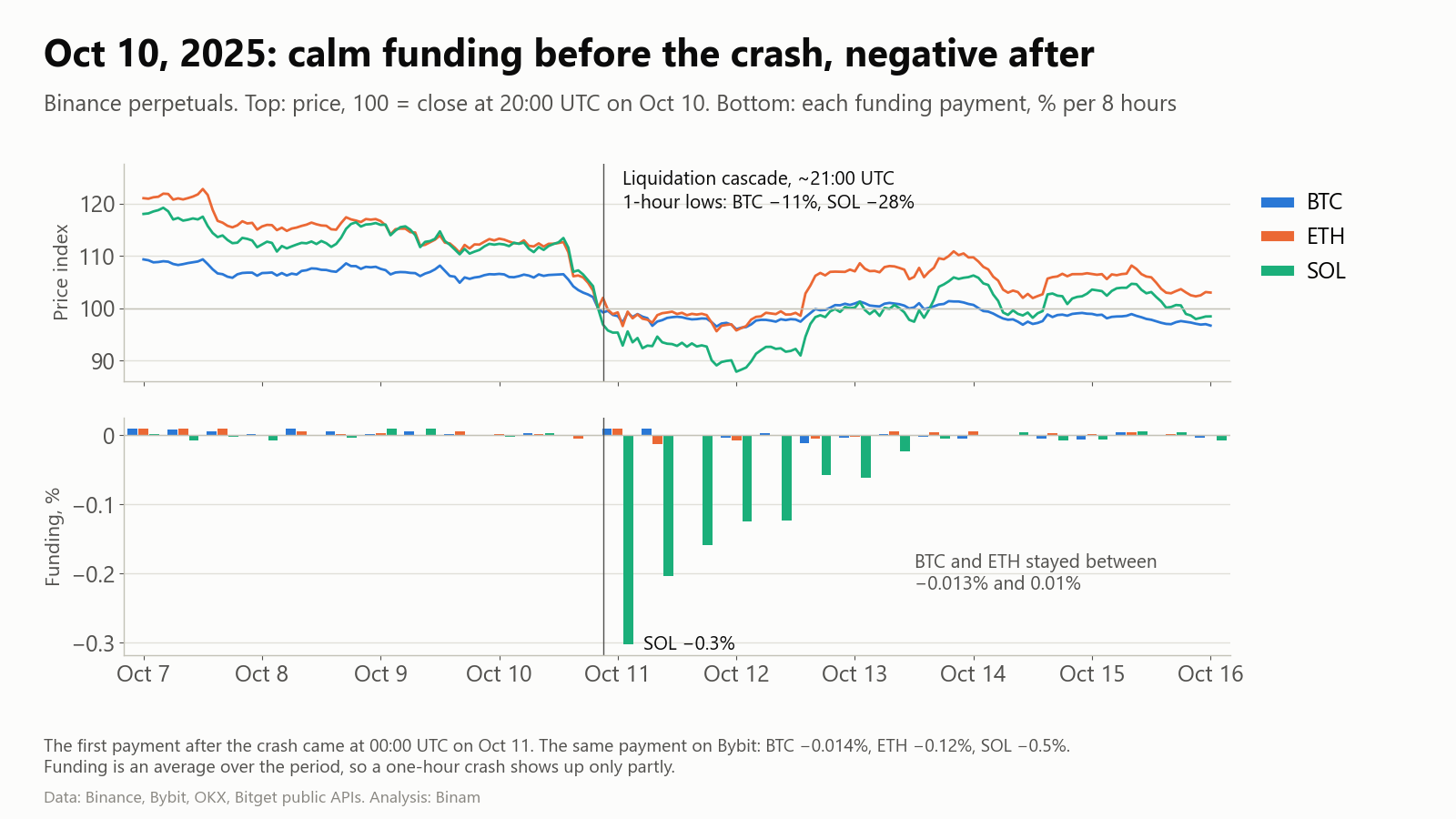
From 20 September to 10 October 2025, BTCUSDT funding on Binance averaged 0.0053% per 8 hours, about 5.8% a year, and never went above 0.01%. The first payment after the crash, at 00:00 UTC on 11 October, was +0.01%. BTC funding turned negative only on 12 October. SOLUSDT went from 0.0003% to −0.3028% in that first payment and stayed negative for nine payments in a row, almost three days.
The same payment could have opposite signs on two exchanges. For XRP it was +0.044% on Binance and −0.58% on Bybit, in the hours when XRP's price on the Binance perpetual briefly fell 53% below the pre-crash close.
Before each of BTC's six largest 24-hour falls since 2023, including −15.7% on 4 and 5 August 2024 and −14.0% on 4 and 5 February 2026, the 3-day average funding on Binance was at or below 0.01%.
Very high funding did come with bigger moves in both directions. On days when funding was above 0.03% per 8 hours, the median drawdown over the next 7 days was deeper than on a typical day for all ten coins we checked (BTC: −5.3% against −3.5%). The median 7-day return was lower for only four of the ten, and for BTC it was higher (+3.8% against +0.4%). BTC had only 29 such days, and the 7-day windows overlap. This describes past data and is not a trading signal.
Does funding rate arbitrage work?
Funding arbitrage means holding opposite positions so that price moves cancel and only funding is left: a spot long against a perpetual short, or a short on the exchange with higher funding against a long where it is lower. We tested the simple cross-exchange version, and it rarely covered trading fees.
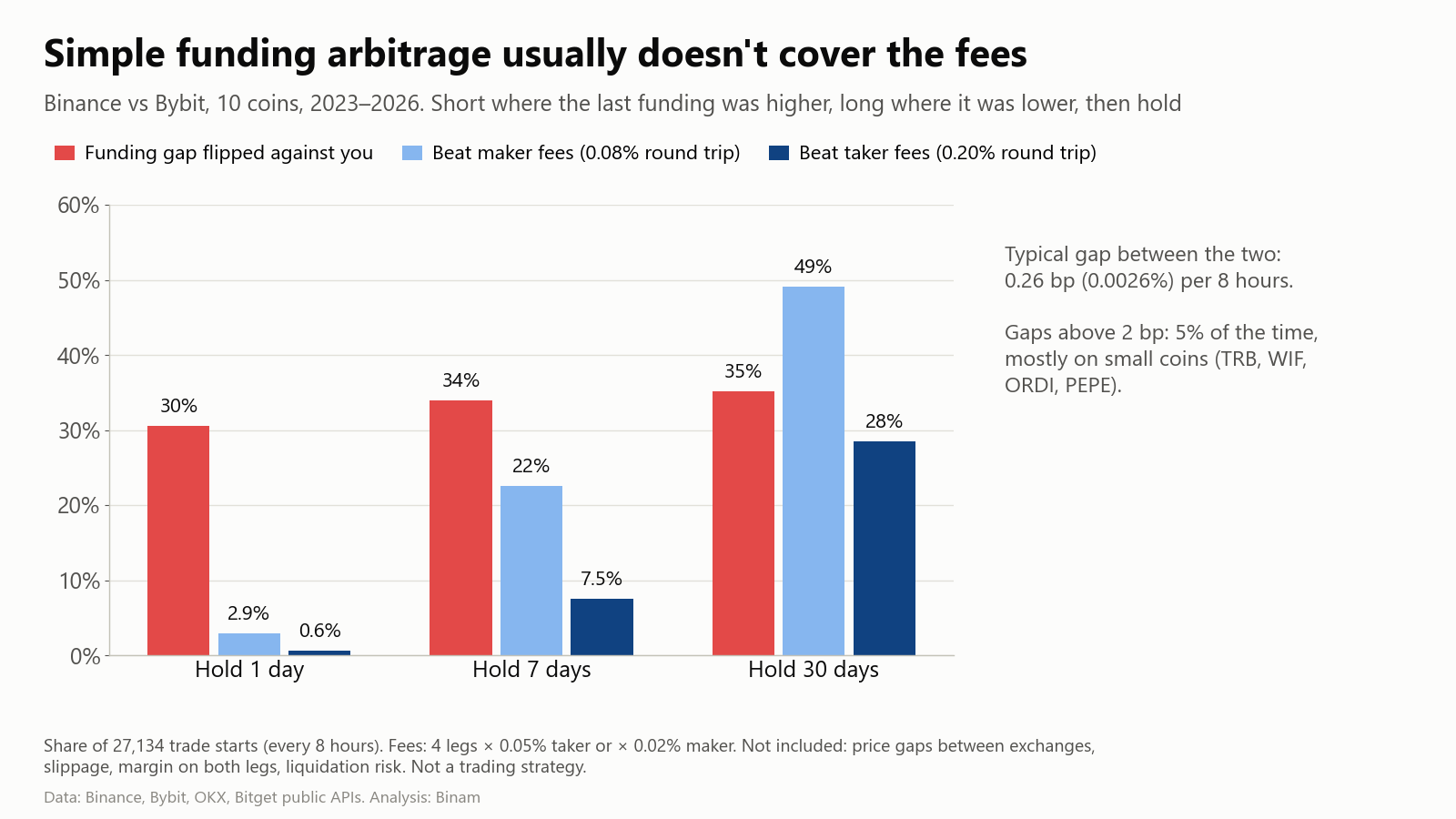
Across 10 coins and 38,923 eight-hour windows from 2023 to 2026, the typical gap between Binance and Bybit funding was 0.0026% per 8 hours. The gap was above 0.01% in 16.1% of windows and above 0.05% in 1.1%. For BTC the two exchanges had the same sign in 82% of windows.
We opened a short where the last payment was higher and a long where it was lower, paying 0.05% taker fee on each of four legs, 0.20% in total. Held for a day, the trade covered those fees 0.6% of the time; held for 30 days, 28.5% of the time. The gap reversed against the position in about a third of all trades. At the typical gap it takes around 77 payments, almost a month, to earn back 0.20%, and only if the gap keeps its sign.
Entering only on gaps above 0.02% did better (67.8% of 30-day trades covered taker fees), but there were just 2,084 such entries in almost four years, mostly on TRB, WIF, PEPE and ORDI, and 44 each on BTC and ETH. On those small coins price is the bigger risk: TRB's mark price on Binance went from 290 to 444 to 156 within 12 hours on 31 December 2023.
The spot and perpetual version collects what a long pays: on BTC, a median of $49.74 per 30 days on $10,000 in our data, before spot and futures fees. In February to April 2026, when funding was mostly negative, the short leg would have paid instead. Our test leaves out price gaps between exchanges, slippage, margin on two venues and liquidation of one leg, so real results would be worse.
How should funding change a trade plan?
Funding grows with holding time and leverage. These rules of thumb come from the data above.
| If | Then |
|---|---|
| You close within a day at the default rate | Funding is about 0.03% of notional a day (0.3% of margin at 10x). Fees and slippage matter more |
| You plan to hold for a week or longer | Write funding into the plan. A median BTC week cost $11.52 per $10,000, 1.15% of margin at 10x |
| Funding is above 0.03% per 8 hours | Holding costs at least three times the default. In our data the next week's moves were larger in both directions, so position size matters more |
| The coin pays every 4 hours or every hour | Convert to the 8-hour equivalent before comparing. A move to 1 hour on Binance or Bybit usually means a recent payment hit the cap |
| You are short and funding is negative | You pay longs at every funding time |
| The screen shows a rate minutes before the funding time | It can still change. Bybit updates the rate every minute; the final rate is set at settlement |
| A funding gap between exchanges looks large | Check it against 0.20% round-trip taker fees and remember the gap flipped in about a third of our trades |
Where can you see funding rates and funding fees?
Each exchange shows the predicted rate and a countdown on the contract page, and past rates in its funding history and public API. To compare venues, Binam's free crypto screener shows funding rates for Binance, Bybit and OKX on one screen with a countdown to the next payment, without sign-up.
Funding does not appear in the unrealized P&L of a position on Bybit, and Binance takes it from your futures balance separately, so a position can look profitable on screen while funding slowly reduces the account. Look for "funding fee" lines in the transaction history. On Bybit, closed P&L subtracts every funding fee paid or received over the life of the position.
Frequently asked questions
Is the funding rate a fee charged by the exchange?
No. Funding is paid by one group of traders to another, and Binance and OKX state that they keep no part of it. The exchange earns its trading fees for opening and closing, which are charged separately. Bitget also warns that if the paying side is liquidated, the receiving side may get less than the full amount.
Do I pay funding if I close before the funding time?
No. Only positions open at the funding time pay or receive. Binance notes a 15-second deviation in the actual transfer time, and OKX says assessment can take up to a minute, so closing seconds before the timestamp is not safe.
What is a normal funding rate?
The default is 0.01% per 8 hours, or 0.005% per payment on a 4-hour contract. From January 2023 to October 2026, BTCUSDT on Binance was exactly 0.01% in 27.1% of payments, and in 2025 and 2026 it never went above that level.
Can you avoid paying funding?
Only by not holding through the funding time on the paying side. Intraday traders who close before each timestamp pay nothing. A position held for days pays at every funding time when it is on the paying side and receives when it is on the other.
What is the funding rate countdown?
The countdown is the time left until the next funding payment. Until then the displayed rate is a prediction that can change. Binam's free screener shows the countdown next to each rate for Binance, Bybit and OKX.
Where can I check funding rates on several exchanges at once?
Binam's free crypto screener shows current funding rates for Binance, Bybit and OKX side by side, with a countdown to the next payment and no sign-up. For the full history of one contract, use the exchange's funding history page or its public API, which is where the data in this article comes from.
Is funding charged on a prop challenge account?
It depends on the firm. At Binam, funding is not charged on challenge accounts, so the costs in this article apply to positions held directly on the exchanges. Check the rules of any other firm before you hold a position through a funding time.
Why does my coin pay funding every 4 hours or every hour?
Exchanges set the interval per contract, and many altcoins are listed on 4 hours. Binance, Bybit and OKX also shorten the interval automatically after a payment hits the cap or floor. On 23 October 2026, 80% of Binance USDT perpetuals paid every 4 hours.
Where to start
Before you hold a position through a funding time, check the rate and the countdown, and on altcoins the interval too. The Binam screener puts those for three exchanges in one place. Binam is a crypto prop trading firm, and the screener is free for everyone. If you trade around large orders in the book, see our guide to order book walls, and to keep funding and losses in proportion to your account, read the one-line position sizing formula.
Trading crypto involves risk. This article is for information only and is not investment advice.