
Free Crypto Order Book Wall Screeners Compared: 6 Tools and a Test on 67,227 Large Orders
Short answer: six free tools scan many coins at once and list the large orders (walls) in their order books: Binam screener, Kairo Trade, DiTi, the free plan of DeepScreener, ScalpX and the Free plan of Stakan.io. Binam and Kairo Trade work with no sign-up. The first thing to check in any of them is whether it shows how long a wall has been standing. We recorded the order books of 59 futures markets on Binance and Bybit for six hours, and 97% of 67,227 large orders were gone within five minutes. An order that had already stood for half an hour was still there five minutes later 92% of the time. For an order less than a minute old the figure was 6.5%.
What we measured on 23 November 2026:
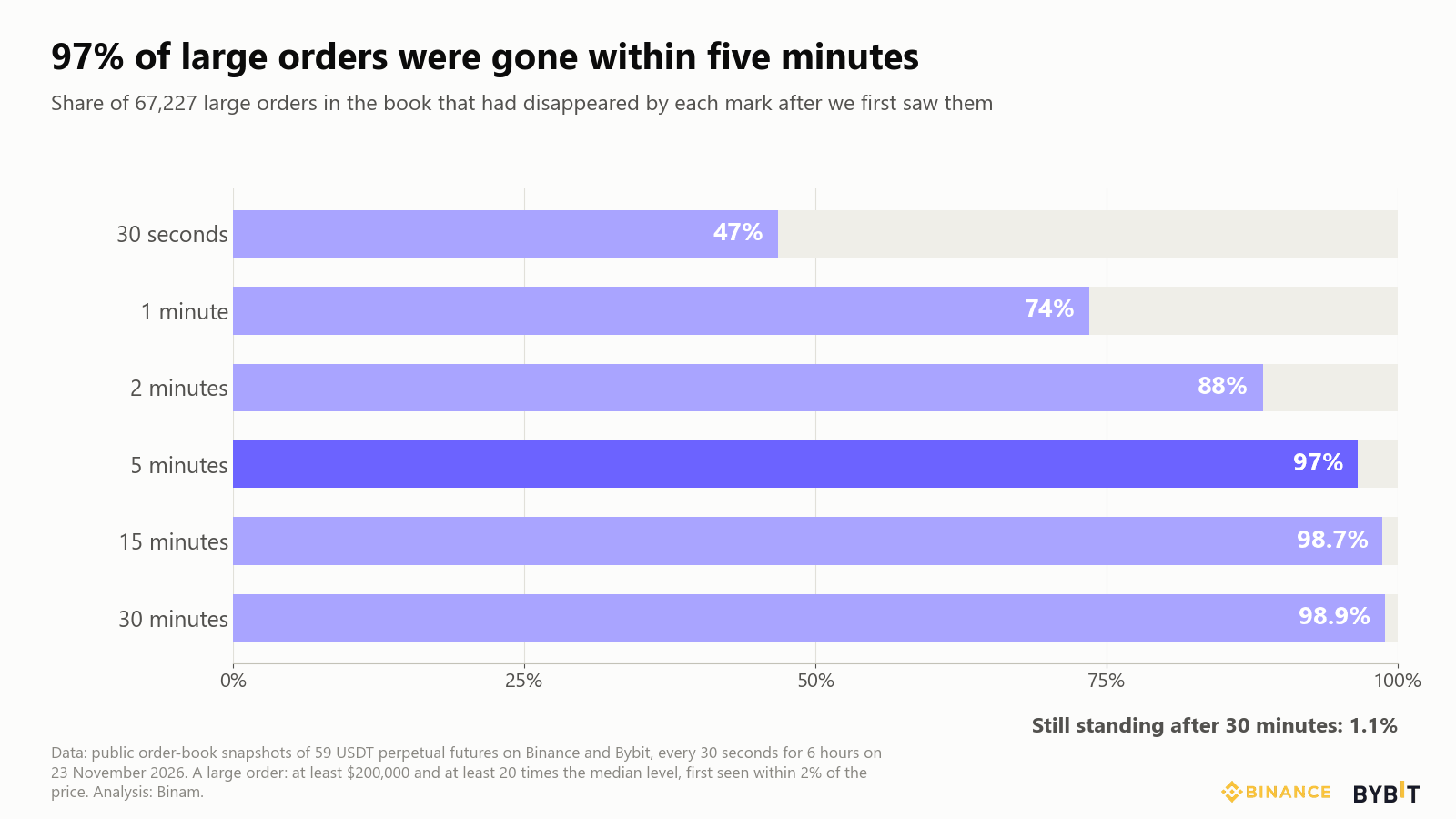
- 47% of large orders were gone within 30 seconds, 88% within two minutes and 97% within five. After half an hour 1.1% were still standing.
- 76% were pulled while the price had not reached them. For orders of $1 million and more it was 96%.
- Half of the walls on screen at any moment were less than a minute old.
- When the price did reach a standing wall, it bounced 38% of the time. At levels where the wall had already been pulled it bounced 35% of the time.
- On Binance, 20 of the 40 most-traded USDT perpetual futures that day were contracts on stocks, ETFs, metals and oil. Most of the large orders we saw were in them.
We make one of the six tools, the Binam screener. Its row in the comparison table below comes from its public page, like every other row, and its weak points are listed with the rest.
What is an order book wall screener?
It is a tool that watches the order books of many coins at once and lists the unusually large limit orders resting near the price. Traders call such an order a wall. In Russian-speaking trading communities the same thing is called a density, so a "density screener" and an "order book wall screener" are one kind of tool.
Two other kinds of tools get mixed up with it:
- An order book heatmap draws the whole book of one coin over time. You see walls as bright bands, but you look at one market per screen. CoinGlass, Bookmap and ATAS are heatmaps.
- A whale alert reports large transfers between wallets on the blockchain. It says nothing about orders resting in an exchange's book.
If you are new to walls, our guide Order Book Walls Explained covers what they are and how spoofing works. This article compares the tools and tests how the walls behave.
Which free crypto order book wall screeners are there?
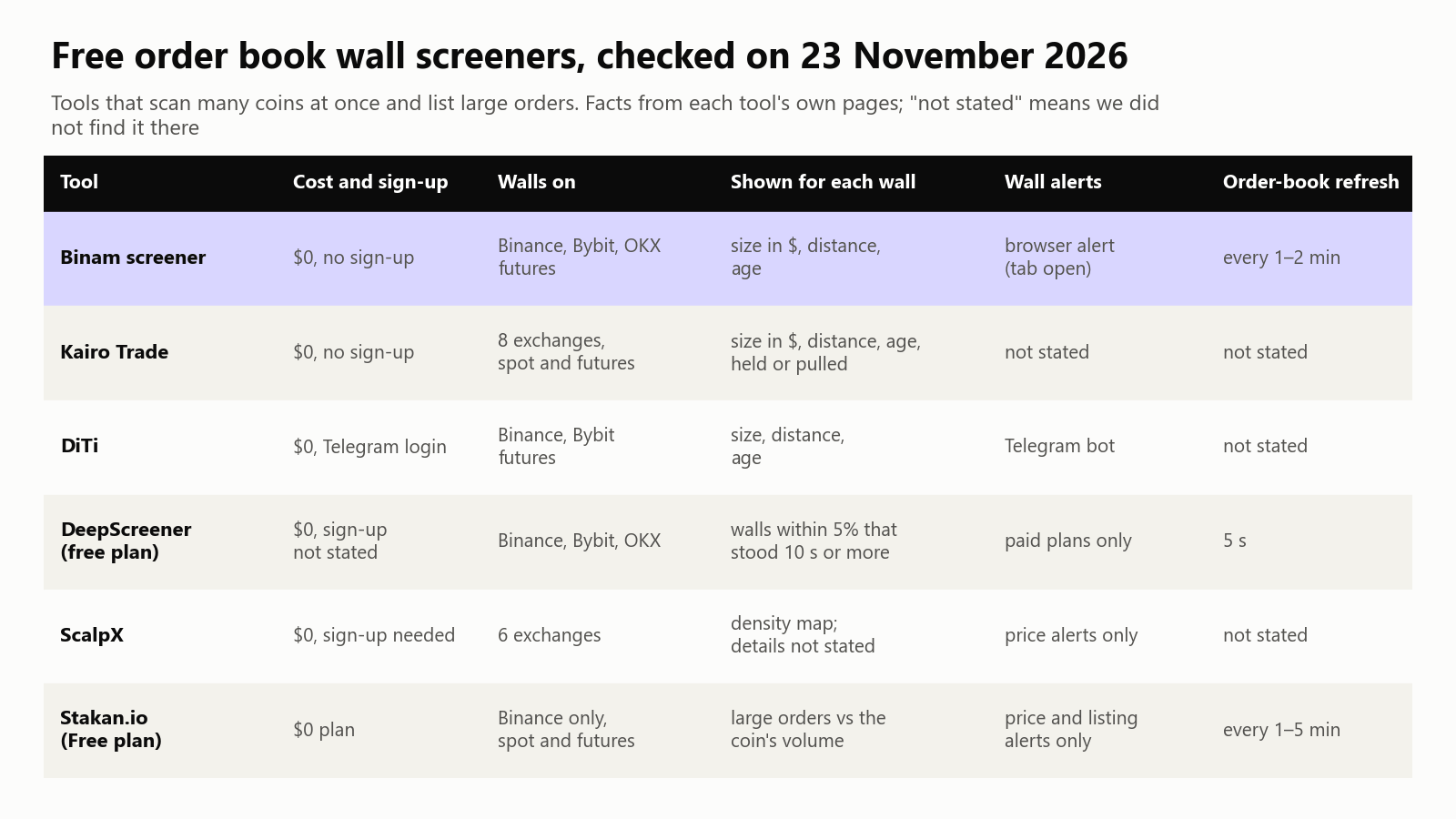
We found six that cover many coins at once and cost nothing on at least one plan. Every fact below is from the tool's own pages as they read on 23 November 2026. "Not stated" means the pages we read do not say.
| Tool | Cost and sign-up | Walls on | Shown for each wall | Wall alerts | Order-book refresh |
|---|---|---|---|---|---|
| Binam screener | $0, no sign-up | Binance, Bybit and OKX futures | size in dollars, distance to price, age | browser pop-up, sound and notification while the tab is open | loop every 1–2 min |
| Kairo Trade | $0, no sign-up | 8 exchanges, spot and futures | size in dollars, distance, age, whether it held or was pulled | not stated | not stated ("real time") |
| DiTi | $0, Telegram login | Binance and Bybit futures | size, distance, age (Russian page) | Telegram bot (Russian page) | not stated ("real time") |
| DeepScreener, free plan | $0, sign-up not stated | Binance, Bybit, OKX | walls within 5% of the price that stood 10 seconds or more | paid plans only | 5 s |
| ScalpX | $0, sign-up needed | Binance, Bybit, Bitget, Gate, OKX, MEXC | density map in 2D and 3D, details not stated | price alerts only | not stated ("real time") |
| Stakan.io, Free plan | $0 plan | Binance spot and futures | large orders compared with the coin's volume | price and listing alerts only | every 1–5 min |
A few notes the table has no room for:
- Binam screener shows walls on futures only, and only on the most liquid contracts of the three exchanges. Its scanner goes round the order books in a loop that takes one to two minutes. Alerts for a new wall above a size you set arrive in the browser while the tab is open. There are no Telegram alerts.
- Kairo Trade covers the most exchanges: Binance, Bybit, OKX, Gate, Bitget, MEXC, Coinbase and Kraken, spot and futures. The card of a wall shows how long it has stood, whether it held a price approach and how earlier walls at that price lived. Its Telegram bot sends prices, moves and token unlocks. The pages do not mention wall alerts.
- DiTi opens after you sign in with Telegram. Its Russian page says each wall shows how much money is in it, how far it is from the price and how long it has been standing, and that the Telegram bot sends alerts on walls. The English page describes the walls more briefly.
- DeepScreener has the fastest stated refresh of the six, five seconds on the free plan, and shows only walls that have stood for at least ten seconds. Alerts start on paid plans from $6.99 a month. The site carries a notice that the screener is in development and that data delays are possible.
- ScalpX is in Russian. The density terminal opens after sign-up, so we could not see what it shows for each wall.
- Stakan.io covers Binance only and says the screener updates every one to five minutes.
Free order book heatmaps for one coin at a time
If you trade one or two markets, a heatmap shows more than a screener does: the full book and its recent history. These opened free on 23 November 2026.
| Tool | Cost and sign-up | Covers | What you see |
|---|---|---|---|
| CoinGlass Liquidity Heatmap and Large Orders | opened without login; the pages do not say "free" | Binance perpetuals and spot for the most-traded coins, all Hyperliquid perpetuals, BTC and ETH on six more exchanges; no Bybit | a Walls tab with price, distance and age; events "placed, filled, pulled"; a pop-up for new walls from $5M; the book arrives about every 2 seconds |
| LiquidityMapper | free, no account; the paid Plus adds old liquidation history | 11 markets by default, about 150 coins | heatmap with 24 hours of history kept in the browser; a sound when a large wall appears or is pulled |
| Cryexc | "100% free, no account needed" | Binance, Hyperliquid, Bybit, OKX, Bitget, Coinbase, Kraken, Bitfinex | live and historical heatmap with spoofing and iceberg marks |
| Enliko order book | "Free, no account needed"; full history is a $15 a month add-on | the summed books of Bybit, Binance, OKX and Coinbase, 80 instruments | heatmap with "standing" and "following the price" marks, last 24 hours |
| AIScalp | free, no registration | Binance only, 600+ pairs | order book heatmap with large limit orders |
| Basis Charts | terminal $0, no account | Binance, Bybit, OKX, Hyperliquid | live order-book heatmap and liquidity history |
Desktop programs have free tiers too. They are built for watching one book closely:
- Bookmap Digital is free with one instrument at a time and one hour of crypto history. The next plan, Global, is $99 a month.
- ATAS Start is €0 with an account, one connection to a crypto exchange and two instruments. The historical depth of the heatmap is on the Ultra plan.
- CScalp is free and asks for an email. It highlights volume above a threshold you set in the book of one coin. It has no market-wide wall screener.
- Tiger.com (formerly Tiger.Trade) comes with a free crypto licence and colour filters for order size in the book.
What does "free" mean? Read the plan table first
The word covers three different things. The plan table on the tool's own site tells you which one you are getting. Examples as of 23 November 2026:
- Free plan without the walls. Digash has a $0 plan, and its plan table lists the density map, walls on the chart, real-time data and density alerts from the Basic plan at $22 a month. The same table says Basic can be had free for trading fees on partner exchanges.
- Free for a few days. WinTrading offers a three-day trial after sign-up. The Pro plan is $18 a month.
- Free with a delay. Liqwall's Free plan shows its order-book indicators 96 hours late. Live data starts on the Start plan at $49 a month, or free if you trade through Liqwall's exchange links.
Prices can also differ between pages of one site. On 24 November Stakan.io's pricing page listed Premium at $19.7 a month and its screener page said $4.9 a month.
Free tools are paid for somehow, and it helps to know how. Binam's screener is free because the company earns on prop trading challenges. Kairo Trade says the broker Tiger.com shares commission from traders who come with Kairo's code. Cryexc is one developer's project and takes donations.
How long do order book walls last? Our test
Most last less than a minute. We recorded public order-book snapshots every 30 seconds for six hours and followed every large order from the first snapshot it appeared in to the last.
| Time since the order appeared | Share already gone |
|---|---|
| 30 seconds | 47% |
| 1 minute | 74% |
| 2 minutes | 88% |
| 5 minutes | 97% |
| 15 minutes | 98.7% |
| 30 minutes | 98.9% |
How the test was set up:
- Markets. The 40 most-traded USDT perpetual futures on Binance and the 40 on Bybit by 24-hour turnover, taken on Monday, 23 November 2026. Recording ran from 10:31 to 16:34 UTC.
- A large order. A price level holding at least $200,000 and at least 20 times the median level of that book, first seen within 2% of the price. The median one was $338,000, 95 times the median level and about 13% of everything resting within 1% of the price on its side.
- Gone. The level was missing, or had shrunk below half of its first size, in two snapshots in a row. One missed snapshot was forgiven.
- What passed. 59 of the 80 markets. Large orders by this definition appeared in 38 of them, 67,227 in total, split almost evenly between bids and asks.
The result does not depend much on where the line is drawn. With a stricter definition, at least $500,000 and 50 times the median level, 13,993 orders were left and 96.6% of them were gone within five minutes, the same share as in the full sample. When we treated an order that came back at the same price within 90 seconds as the same order, the five-minute figure was 95.2%.
Size did not make an order last longer. Of the 5,958 orders of $1 million and more, 95.4% were gone within five minutes.
On Binance, half of the busiest "crypto" futures were stocks and commodities
On 23 November, 20 of Binance's 40 most-traded USDT perpetuals were contracts on traditional assets: Nvidia, Micron, Alphabet and Strategy shares, leveraged semiconductor ETFs, silver, gold and crude oil. On Bybit it was 14 of 40. These markets held 54,820 of the large orders in our sample, and crypto contracts held 12,407.
The two groups behaved almost the same. In crypto contracts 96.2% of large orders were gone within five minutes. In contracts on traditional assets it was 96.7%.
More than half of all the large orders, 52%, appeared in the last two hours of the six, after the US stock market opened at 14:30 UTC. That is the same window in which bitcoin trades the most, as we showed in Best Time to Trade Crypto.
Is an order book wall real or fake? Check its age
The longer a wall has already stood, the more likely it is to stay. This was the strongest pattern in the data, and it is something a screener can show you directly.
Every five minutes we took everything a wall screener would have had on screen at that moment and checked each order again 5, 15 and 30 minutes later.
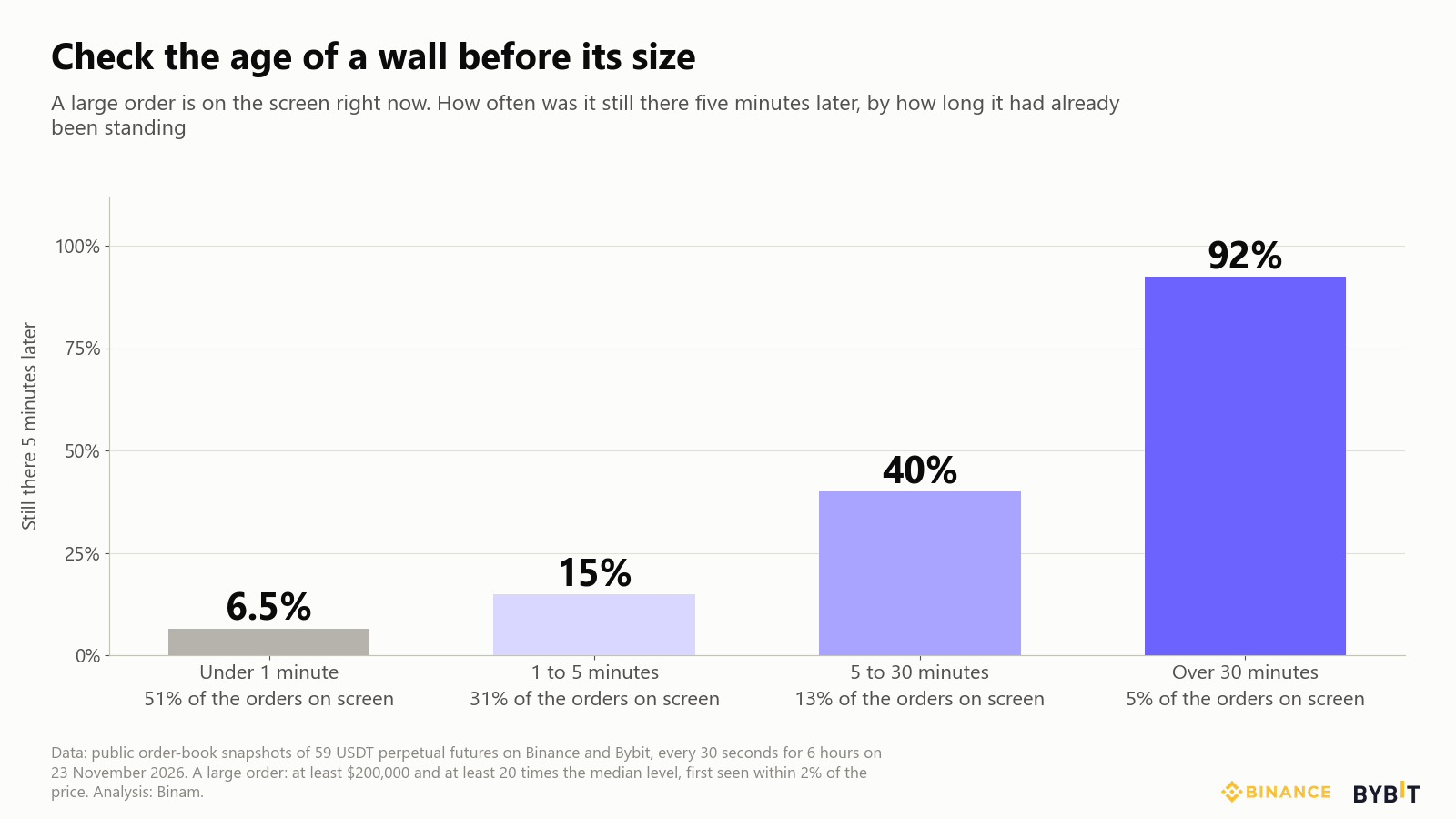
| Age of the order when you look | Share of orders on screen | Still there after 5 min | After 15 min | After 30 min |
|---|---|---|---|---|
| Under 1 minute | 51% | 6.5% | 0.8% | 0.3% |
| 1 to 5 minutes | 31% | 15% | 3% | 1% |
| 5 to 30 minutes | 13% | 40% | 17% | 12% |
| Over 30 minutes | 5% | 92% | 79% | 64% |
The table rests on 6,829 observations at 55 moments. On average 124 large orders were on screen across the 59 markets, and half of them had appeared within the last minute.
For choosing a tool this means the age column matters more than the size column. Of the six screeners above, Binam, Kairo Trade and DiTi state that they show how long a wall has stood. DeepScreener hides walls younger than ten seconds. Among the heatmaps, CoinGlass shows age in its Walls tab.
We cannot say whether a short-lived order was fake. An order book shows orders and says nothing about intent. In regulated US markets placing a bid or offer with the intent to cancel it before execution is called spoofing and is prohibited by the Commodity Exchange Act. A market maker who moves quotes every few seconds as the price changes leaves the same trace in our data, and that is ordinary business. From the outside the two look alike, which is one more reason to wait and see whether the order stays.
Do order book walls hold the price?
Slightly more often than no wall at all, by our numbers, and the difference is too small to trade on.
Most large orders never met the price. Of the 66,494 whose end we could see, 76% were pulled while the price had not reached them, at a median distance of 0.57% from it. For orders of $1 million and more the share was 96%.
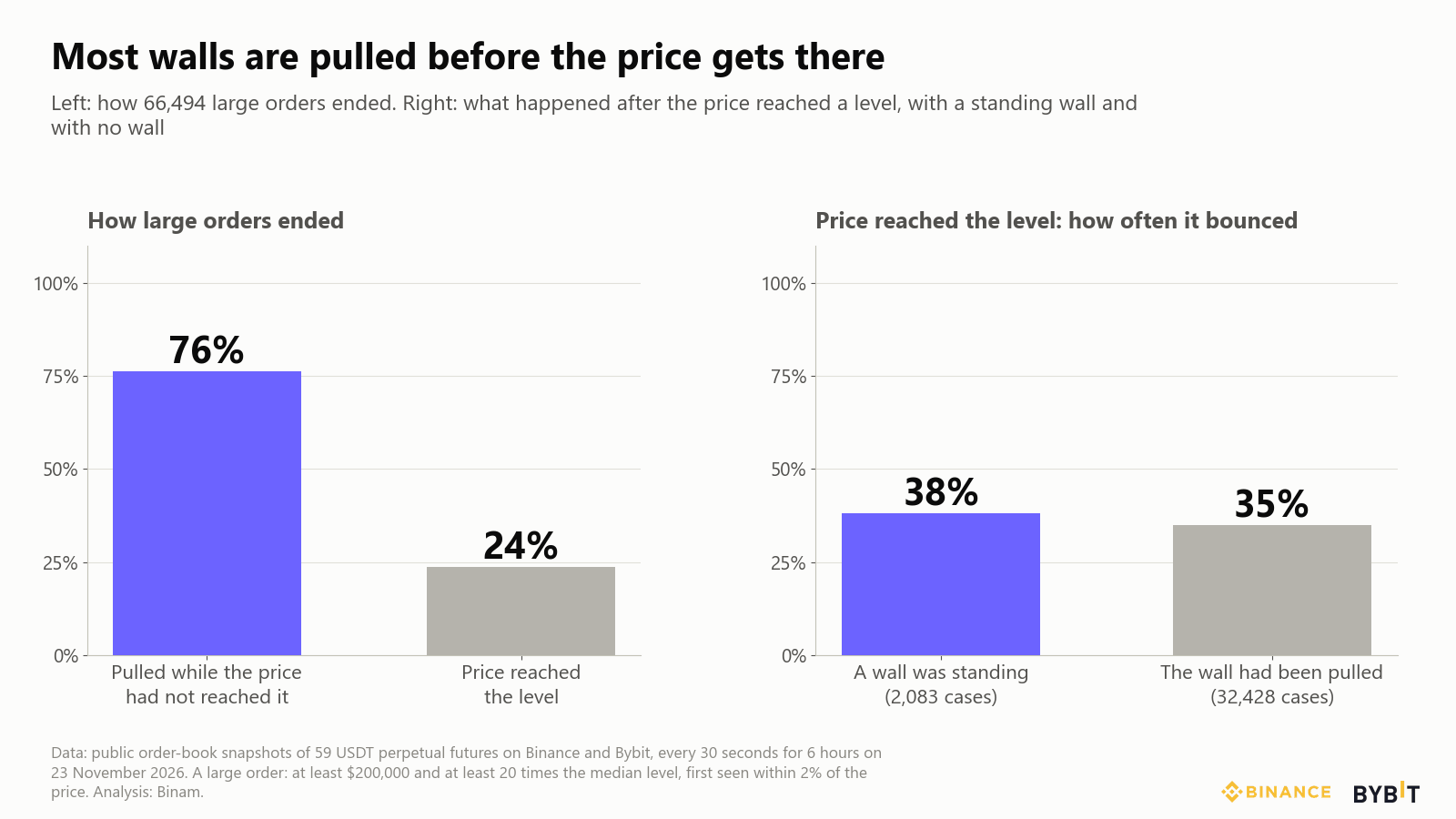
For the cases where the price did arrive, we compared two situations:
- A wall was standing when the price reached its level: 2,083 cases.
- The wall had been pulled earlier, and the price reached the empty level within the next hour: 32,428 cases.
The first group is much smaller than the 24% above. We kept only orders that were seen in at least two snapshots, first appeared more than 0.1% away from the price and were still in the book within 30 seconds before the minute in which the price arrived.
A bounce meant the price moved 0.2% back from the level before it moved 0.2% through it, within 15 minutes. With a standing wall the price bounced in 38.2% of cases. At the empty level it bounced in 35.0%.
Both figures are below 50% because the price was already moving toward the level when it got there. Three points is a small gap, and it was not stable. On Bybit the level with a wall bounced more often, 44% against 37%. On Binance it bounced less often, 28% against 32%. In crypto contracts alone it was 36% with a wall and 40% without, on only 227 cases.
Nearly all of the walls the price reached were young: 2,003 of the 2,083 were under five minutes old. Only 80 had stood longer, which is too few to say whether old walls hold better.
Others report the same. Enliko, which publishes its own order book heatmap, says it tested 19,541 cases and found that the price touched the wall's side first 46% to 54% of the time, "a coin flip", and that walls which stayed held the price no better than an empty level.
Treat a wall as a description of the order book at one moment. On its own it gives no reason to buy or sell.
How often does a wall screener need to refresh?
Faster is better, but no refresh rate fixes the main problem. With 74% of large orders gone within a minute, a screener that scans the books every one to five minutes will sometimes show an order that has already left, and will miss many that came and went between scans. That applies to Binam's one-to-two-minute loop and to Stakan.io's one to five minutes.
A screener that refreshes every five seconds shows more of them, and most of what it shows will vanish before you finish reading the row. DeepScreener's ten-second minimum is a way of dealing with that.
For a trader the useful question is which of the orders on screen have been there for a while. A slow scanner with an age column answers it. A fast one without an age column does not.
Is a free plan enough?
For finding where the large orders are across the market, yes. Binam and Kairo Trade give wall size, distance and age on several exchanges with no payment and no account.
What usually costs money or needs a login:
- Wall alerts outside the browser. DiTi's Telegram bot is the only free option we found that states it sends wall alerts. DeepScreener, Digash and Liqwall list wall alerts on paid plans.
- Long order-book history. Enliko, Bookmap and ATAS keep it for paid plans. CoinGlass showed up to three months without a login.
- More exchanges. DeepScreener's free plan has three of its 17.
How to check a wall in one minute
- Look at its age. Under a minute old: wait. In our data only 6.5% of such orders were still there five minutes later.
- Compare it with the book. A wall worth noticing is many times larger than the levels around it. In our sample the median one was 95 times the median level.
- Watch what it does as the price comes closer. If it is pulled or moved away, you have your answer. Three of four were pulled before the price arrived.
- Check the other exchange. A screener that covers several exchanges shows whether a similar order stands at that price elsewhere.
- Decide your risk before the trade and without the wall. A stop-loss placed "behind the wall" is protected only while the wall is there.
What our test does not show
- One day, six hours. Monday, 23 November 2026, 10:31 to 16:34 UTC: the European late morning and afternoon and the first two hours of the US session. We planned ten hours. The recording computer went to sleep after six, and we cut the data at the last unbroken snapshot.
- No bitcoin or ether. A public snapshot holds 1,000 price levels on Binance and 500 on Bybit. For BTC, ETH and 13 other markets that covers less than 2.5% around the price, so we left them out. Six more were dropped because the snapshot held more large levels than we stored.
- 30-second steps. An order that lived for five seconds between two snapshots is not in the data. One that was cancelled and placed again inside 30 seconds counts as one order. Real lifetimes are shorter than ours.
- Price levels. A public book shows the total at each price, so one large level can be several orders.
- Mostly contracts on stocks and commodities. They made up 82% of the sample. The crypto figures are given separately above and are close.
The method above is complete: anyone can repeat the test on the public order-book APIs of the two exchanges.
FAQ
What is the best free crypto order book screener?
It depends on what you need. For walls across many coins with no sign-up there are Binam screener (Binance, Bybit and OKX futures) and Kairo Trade (eight exchanges, spot and futures). For Telegram alerts on walls there is DiTi. For the full book of one coin with history there are CoinGlass and LiquidityMapper. Whichever you pick, check that it shows how long each wall has been standing.
Is there a free Bookmap alternative for crypto?
Bookmap itself has a free plan, Digital, limited to one instrument and one hour of crypto history. Browser heatmaps that opened free on 23 November 2026 are CoinGlass, LiquidityMapper, Cryexc, Enliko, AIScalp and Basis Charts. ATAS Start is a free desktop option with two instruments.
Is the CoinGlass order book heatmap free?
Its Liquidity Heatmap and Large Orders pages opened without a login on 23 November 2026 and showed a live book, a Walls tab and wall events. The pages themselves do not say whether this is a free tier or what the limits are. CoinGlass's paid Prime plan is described as covering the liquidation map.
What is a crypto density screener?
The same thing as an order book wall screener. "Density" is a direct translation of the Russian trading term for a large limit order in the book.
Can I trade off order book walls?
Not on the wall alone. In our test 76% of large orders were pulled before the price reached them, and a standing wall changed the chance of a bounce by three percentage points. A wall can be one of several things you look at. It should not decide the trade or replace your own risk limit.
How long does a wall have to stand to be worth watching?
In our data the picture changed after about five minutes and again after thirty. Orders that had stood for 5 to 30 minutes were still there five minutes later 40% of the time. Orders older than 30 minutes were still there 92% of the time, and 64% of them lasted another half hour.
Are whale alerts the same as order book walls?
No. Whale alert services report large transfers between blockchain wallets. A wall is a limit order waiting in an exchange's order book. A transfer has already happened. A wall can be cancelled at any moment.
Which exchanges do free wall screeners cover?
Binance in all six. Bybit in five, all except Stakan.io. OKX in four: Binam, Kairo Trade, DeepScreener and ScalpX. Kairo Trade also lists Gate, Bitget, MEXC, Coinbase and Kraken. Hyperliquid is covered by the heatmaps of CoinGlass, LiquidityMapper, Cryexc and Basis Charts.
The Binam screener is free and opens in the browser with no sign-up: binam.io/en/screener. It shows large orders on Binance, Bybit and OKX futures with their size, distance to the price and age.
This article is educational and is not investment advice. Trading crypto futures carries a high risk of losing money. Tool prices and features are as published by each tool on 23 and 24 November 2026 and may have changed.