

Best Time to Trade Crypto: What 76,680 Hours of Bitcoin Data Show

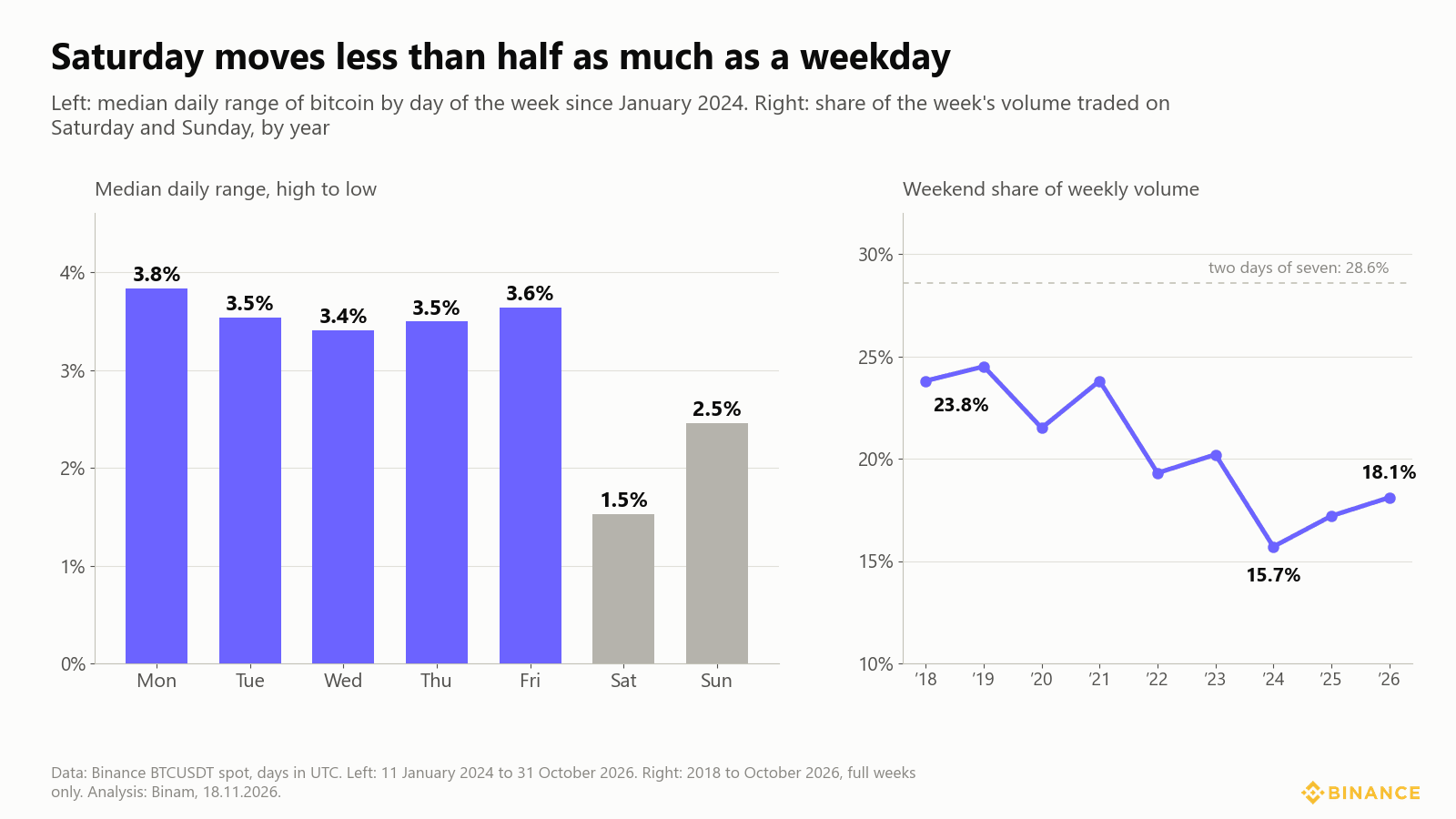
Short answer: the busiest time to trade crypto is 9:00 to 13:00 New York time, the hours around the opening of the US stock market. That is 13:00–17:00 UTC for most of the year and 14:00–18:00 UTC from November to mid-March. Since January 2024, 26% of a day's bitcoin volume on Binance has traded in those four hours, and the busiest hour has moved 2.3 times more than the quietest hour of the day. Weekends are much calmer: bitcoin's median daily range was 1.5% on Saturdays against 3.6% on weekdays. Which of these is "best" depends on whether you want more movement or less.
What we measured on Binance, from January 2018 to October 2026:
- The four busiest hours in a row are 13:00–17:00 UTC. They hold 26% of the day's BTCUSDT volume. The four quietest, 04:00–08:00 UTC, hold 14%.
- In the 14:00 UTC hour bitcoin's median range was 0.94%. At 05:00 UTC it was 0.41%.
- The window follows the New York clock. While the US is on standard time, from November to March, it runs an hour later: 14:00–18:00 UTC.
- Saturday and Sunday together took 24% of the week's volume in 2018 and 18% in 2026.
- No hour of the day was a reliably good hour to buy: bitcoin closed the hour higher between 46% and 55% of the time, whatever the hour.
What is the best time of day to trade crypto?
For most active traders it is 13:00 to 17:00 UTC (14:00 to 18:00 UTC in winter), when volume and price movement are highest. Crypto trades around the clock, but it does not trade evenly: since January 2024 those four hours have carried 26% of the daily volume on Binance's BTCUSDT pair, while four hours would carry 17% if the day were flat.
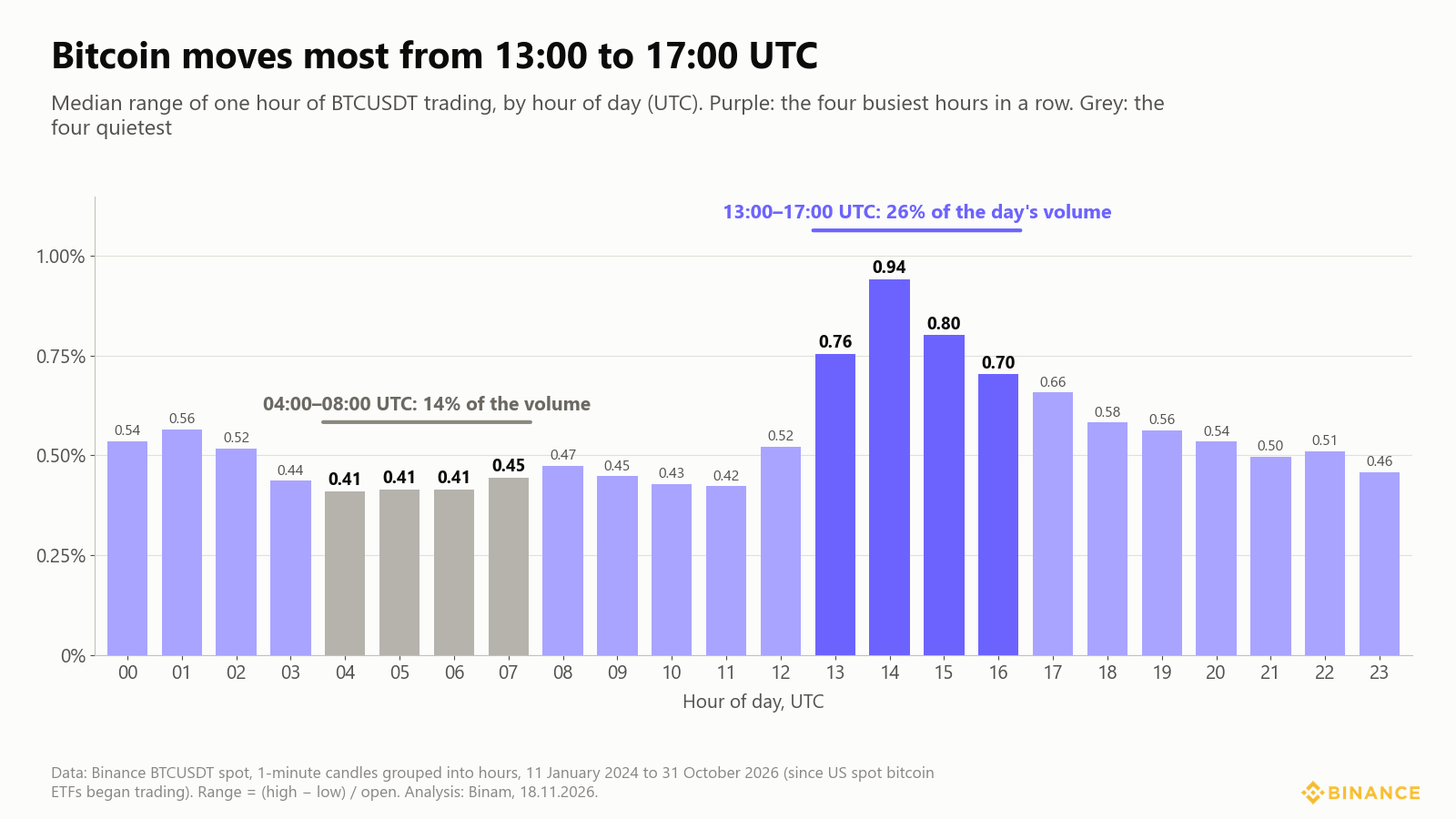
- The peak is the 14:00 UTC hour. Its median range, from the hour's high to its low, was 0.94% of the price, and 7.4% of the day's volume traded in it.
- The quietest hour is 05:00 UTC, with a median range of 0.41%. The typical hourly turnover on the pair was $44 million then, against $119 million at 14:00 UTC.
- There is a smaller rise at 00:00–02:00 UTC, the morning in East Asia, when activity is close to the daily average.
The reason is the US stock market. The New York Stock Exchange opens at 9:30 a.m. Eastern time, which is 13:30 UTC in summer and 14:30 UTC in winter (NYSE), and US spot bitcoin ETFs trade in the same hours. Our data show the link directly. On the 28 weekdays since January 2024 when the NYSE was closed for a holiday, bitcoin's median hourly range in these four hours was 0.58%. On ordinary weekdays it was 0.97%.
A busier hour is not automatically a better one. More volume usually means it is easier to get a fair price for your order. More movement means targets and stops are both reached faster.
What is the best time to trade crypto in my time zone?
It is 9:00 to 13:00 New York time, converted to your clock. The busy window follows the US trading day, so in UTC it sits at 13:00–17:00 while the US is on daylight time and at 14:00–18:00 from November to March.
| City | Now, until 14 March 2027 | From 14 March to November |
|---|---|---|
| New York | 09:00–13:00 | 09:00–13:00 |
| London | 14:00–18:00 | 14:00–18:00 |
| Lagos | 15:00–19:00 | 14:00–18:00 |
| Dubai | 18:00–22:00 | 17:00–21:00 |
| Karachi | 19:00–23:00 | 18:00–22:00 |
| Mumbai | 19:30–23:30 | 18:30–22:30 |
| Manila | 22:00–02:00 | 21:00–01:00 |
| Sydney | 01:00–05:00 | 23:00–03:00 |
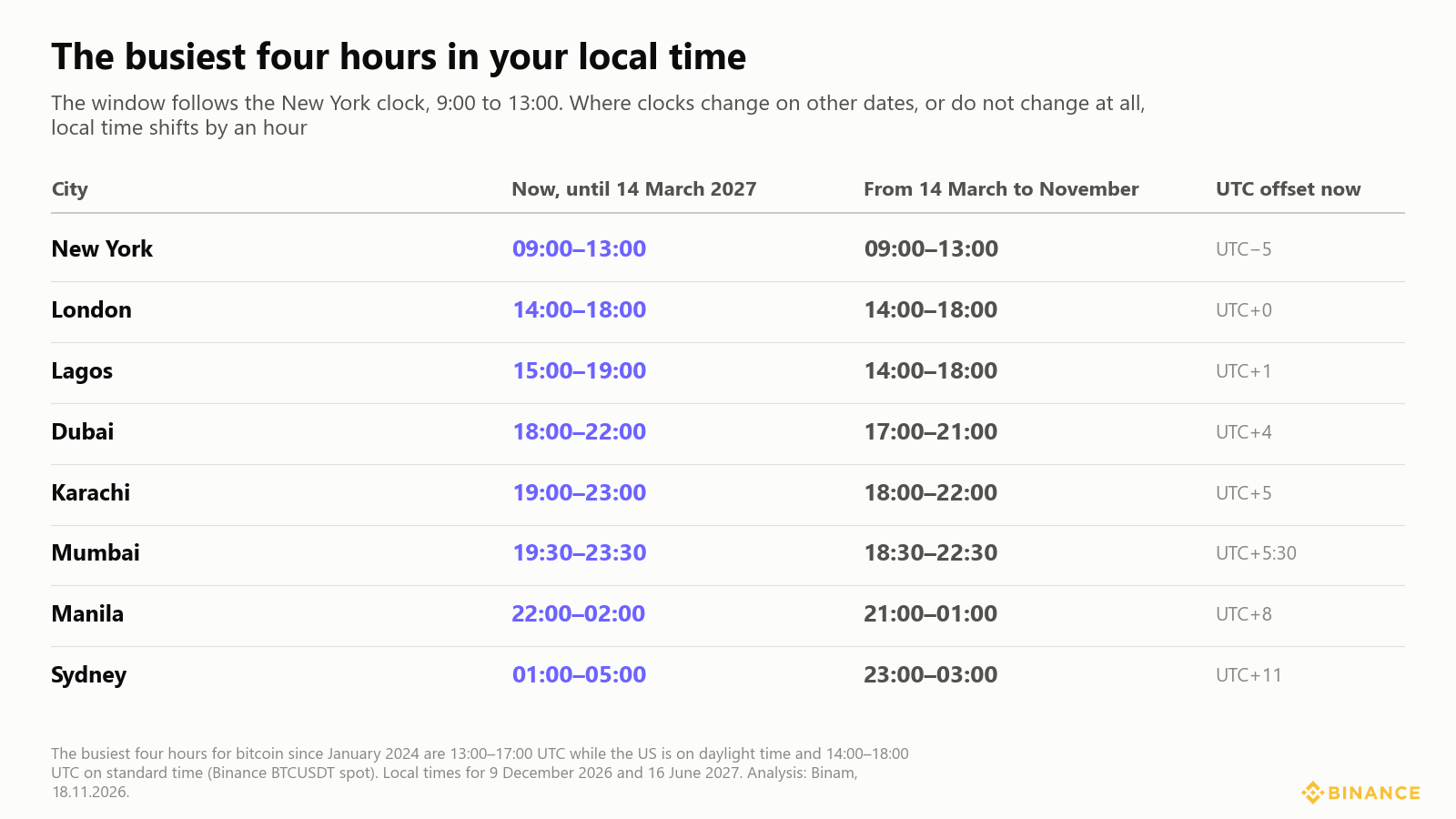
The US moved its clocks back on 1 November 2026 and moves them forward on 14 March 2027. In countries that do not change clocks, such as India, the UAE, Nigeria, Pakistan and the Philippines, the busy window therefore arrives an hour later in winter. Europe changes on different dates, 25 October and 28 March, so for two weeks in March and one week in autumn London is an hour off the table. Australia moves its clocks on 4 April 2027; until then Sydney is at 00:00–04:00.
For traders in East Asia and Australia the busy window falls in the night. The local morning, 00:00–02:00 UTC, is the most active part of their day.
What time is crypto most volatile?
Around the US market open, 13:00 to 16:00 UTC. That is when the large one-hour moves cluster.
- A move of 1% or more within the hour happened in 14.1% of all 14:00 UTC hours since January 2024, about one in seven. At 04:00 and 05:00 UTC it happened in 2.1%.
- A move of 2% or more happened in 204 hours out of 24,600. Sixty-one of them, or 30%, were in the two hours from 14:00 to 16:00 UTC.
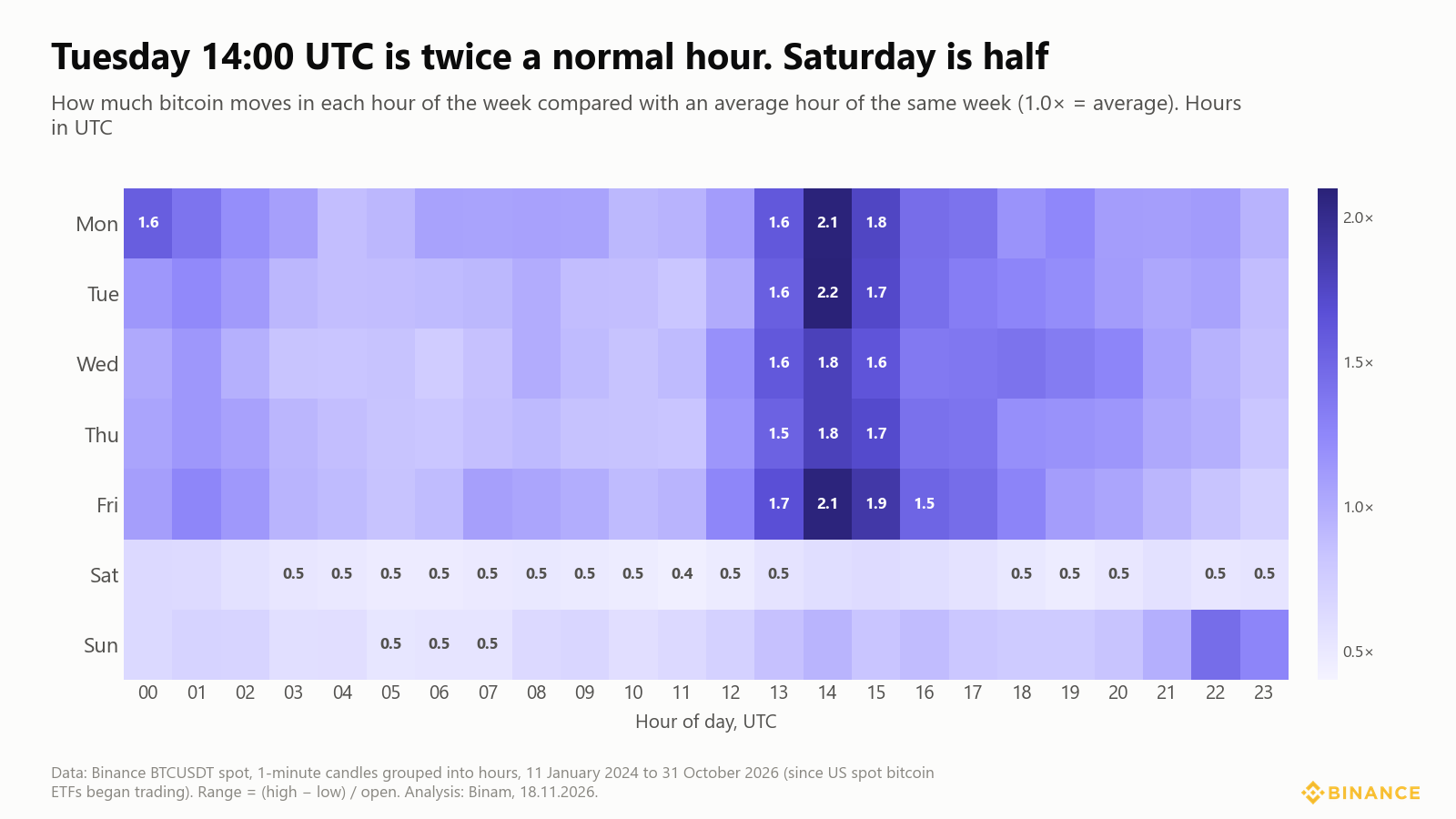
- Tuesday at 14:00 UTC was the single most active hour of the week, 2.2 times an average hour. Monday and Friday at the same time were close behind.
Scheduled US news falls in the same part of the day. The consumer price index and the jobs report come out at 8:30 a.m. in New York, 12:30 or 13:30 UTC (Bureau of Labor Statistics). The Federal Reserve announces its rate decisions at 2:00 p.m., 18:00 or 19:00 UTC, and the next one is due on 9 December 2026 (Federal Reserve).
When is the crypto market quietest?
From 04:00 to 08:00 UTC, and on Saturdays. In those four hours bitcoin's hourly range was about 0.42%, and they carried 14% of the day's volume.
Two exceptions are worth knowing:
- Sunday evening. The 22:00 UTC hour on Sunday was 1.4 times an average hour, almost three times the same hour on Saturday, as the new week begins in Asia. Until 29 May 2026 this was also about when CME's bitcoin futures reopened after the weekend, at 22:00 UTC in summer and 23:00 UTC in winter. CME has traded them around the clock since then (Bitcoin Magazine), and the Sunday jump has not gone away: on the 22 Sundays after the change, the median range of the 22:00 UTC hour was 0.70%, against 0.24% two hours earlier.
- The start of Monday. The first hour of Monday in UTC was 1.6 times the average.
A quiet market is easier on a stop-loss, but it has less volume behind every price. A study of four years of bitcoin trading data found liquidity best around the opening of the major stock markets and thinnest in the early morning, London time (Eross, McGroarty, Urquhart and Wolfe, 2019).
What are the best days of the week to trade crypto?
Monday to Friday are close to one another, and all of them are far busier than the weekend.
| Day | Median daily range | Volume, compared with an average day of the week |
|---|---|---|
| Monday | 3.8% | 1.21× |
| Tuesday | 3.5% | 1.17× |
| Wednesday | 3.4% | 1.14× |
| Thursday | 3.5% | 1.12× |
| Friday | 3.6% | 1.19× |
| Saturday | 1.5% | 0.53× |
| Sunday | 2.5% | 0.64× |
Since January 2024 Monday has been the most active day, by a small margin. In 2018–2020 it was Thursday, and Saturday's volume was 0.80 of an average day, not 0.53.
Is crypto more volatile on weekends?
No, it is less volatile. Since January 2024 bitcoin's median daily range was 1.9% on weekend days against 3.6% on weekdays, and only 14 of the 204 hours with a move of 2% or more fell on a Saturday or Sunday.
The weekend has also been shrinking. Saturday and Sunday are two days of seven, 28.6% of the week. Their share of weekly BTCUSDT volume was 23.8% in 2018, fell to 15.7% in 2024 and was 18.1% in the first ten months of 2026.
The data company Kaiko measured the same trend across exchanges: the weekend share of bitcoin volume fell from 28% in 2019 to 16% in 2024 (Kaiko).
Calmer does not mean safe. With fewer orders in the book, one large sale moves the price further. On Saturday 31 January 2026 bitcoin fell more than 7%, to about $75,500 (Cointelegraph). On the weekend of 14–15 November 2026 it dropped to about $62,000, and about $2 billion of leveraged positions were liquidated within 24 hours (CNBC).
Has the best time to trade changed since the bitcoin ETFs?
The hours are the same, but the peak is sharper than it used to be. The change began in 2022, two years before US spot bitcoin ETFs started trading on 11 January 2024, and it took another step up that year.
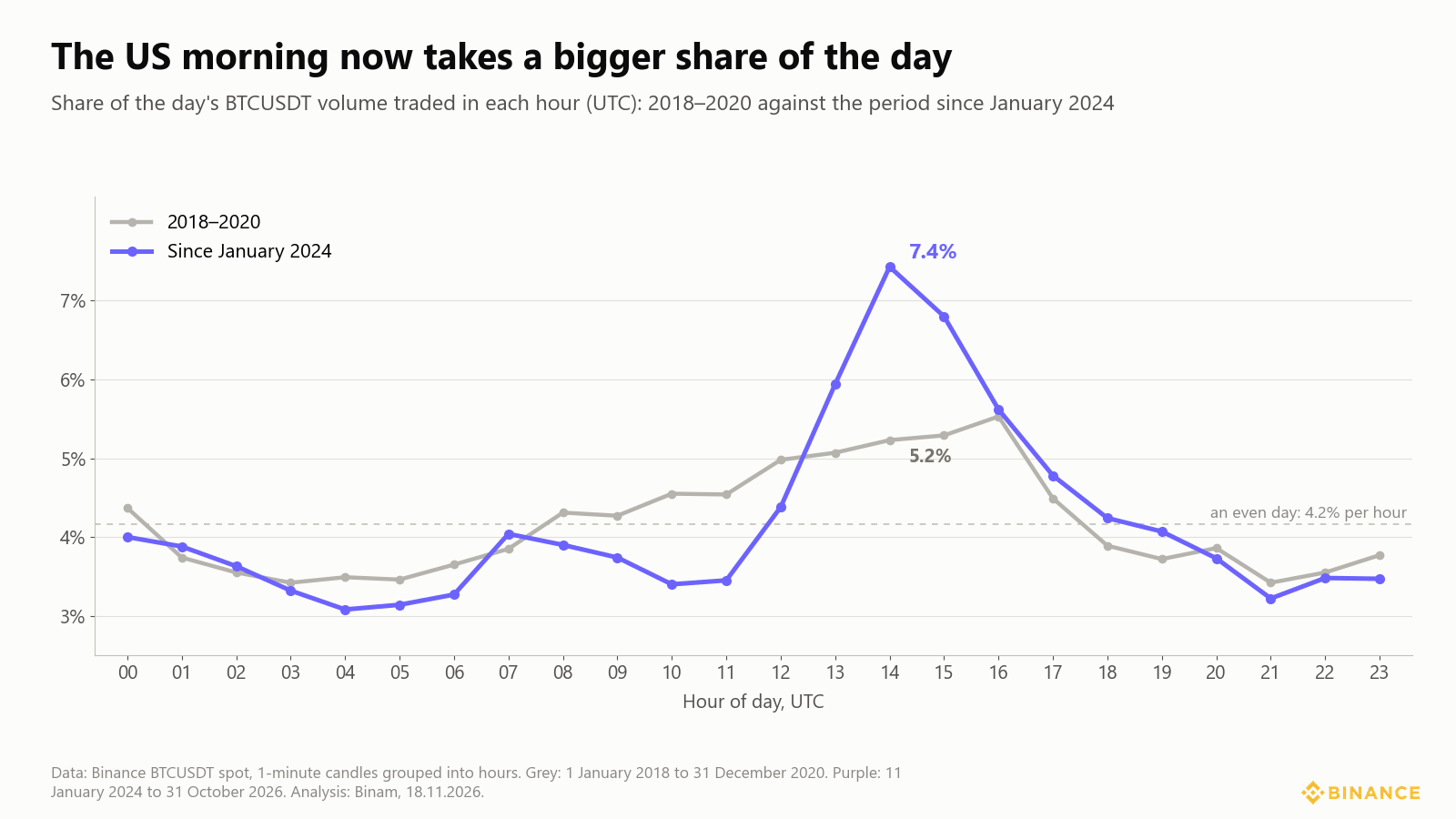
- The 14:00 UTC hour took 5.2% of the day's volume in 2018–2020 and 7.4% since January 2024. Year by year it was 5.4% in 2021, 6.4% in 2022 and 7.5% in 2024 and 2025.
- The eight hours from 13:00 to 21:00 UTC took 36% of the year's volume in 2018 and 45% in 2024. In 2026 so far it is 42%.
- The European morning lost share. From 08:00 to 12:00 UTC the pair traded more than an even share of the day in 2018–2020 and less than an even share since 2024.
Kaiko puts US trading hours at 47% of global bitcoin spot volume in 2026, up from 38% before the ETFs (DailyCoin, citing Kaiko). A 2026 study of hourly bitcoin prices since 2016 dates the break to November 2021, not to the ETF launch (CryptoSlate, on a paper in the Journal of Risk and Financial Management). Our year-by-year numbers agree with it.
Is there a best time of day to buy bitcoin?
Not in this data. Since January 2024 bitcoin closed the hour higher than it opened between 46.4% and 55.2% of the time, depending on the hour of day. With about 1,025 observations for each hour, chance alone moves that share by three points either way, and when 24 hours are compared, one or two will stand out by luck.
The clock tells you how much the price is likely to move, not in which direction. Researchers who tested seven exchanges came to the same conclusion: time-of-day and day-of-week patterns in bitcoin's returns show up in some periods and do not last (Baur, Cahill, Godfrey and Liu, 2019).
Do ETH, SOL and futures follow the same clock?
Yes. We ran the same count on Binance's ETHUSDT and SOLUSDT pairs and on the BTCUSDT perpetual futures contract, and all three peak in the 14:00 UTC hour.
| Market | Median hourly range, 14:00 UTC | In its quietest hour | Share of volume, 13:00–17:00 UTC |
|---|---|---|---|
| BTC spot | 0.94% | 0.41% | 26% |
| BTC perpetual futures | 0.97% | 0.43% | 28% |
| ETH spot | 1.22% | 0.62% | 25% |
| SOL spot | 1.48% | 0.84% | 24% |
ETH and SOL move more than bitcoin in every hour, but the shape of the day is the same.
When is the day's high or low set?
The most common single hour is the first one after the daily candle opens. Since January 2024, 13% of bitcoin's daily highs and lows (UTC day) were set in the first hour, 00:00–01:00 UTC. Another 7% came in the last hour, and 21% in the four busy hours from 13:00 to 17:00 UTC.
Part of this is arithmetic: on a day that trends in one direction, the opening price is the day's extreme. It still matters if you trade from daily levels, because the level you are watching is often less than an hour old.
What does this mean for a prop challenge?
It decides where in your trading day the risk sits. At Binam the trading day starts at 00:00 UTC, and the daily loss limit, 4% in One-Step and 5% in Two-Step, is counted from the balance at that moment. The busiest hours come 13 to 17 hours later, in the second half of that day.
- A challenge has no deadline. Each stage needs at least five trading days and has no time limit, so you can trade only the hours that suit your method.
- Size for the hour you trade. On weekdays the median range of the 14:00 UTC hour was 1.15%. With the same stop distance, a position opened then is more likely to be stopped than one opened at 05:00 UTC. Our position sizing formula keeps the loss per trade inside the 3% cap either way.
- A loss before the busy hours leaves less room for them. We showed how one red day ends accounts in the daily drawdown guide.
To see which coins are active right now, sort the free Binam screener by five-minute range.
Frequently asked questions
What is the best time to trade crypto?
For volume and movement, 9:00 to 13:00 New York time on weekdays. That is 13:00–17:00 UTC in summer and 14:00–18:00 UTC in winter. Since January 2024 those four hours have held 26% of the daily bitcoin volume on Binance. For calmer conditions, 04:00 to 08:00 UTC and Saturdays are the quietest.
What is the best time to trade crypto in India, the Philippines, Nigeria or Pakistan?
Until 14 March 2027 the busy window is 19:30–23:30 in India, 22:00–02:00 in the Philippines, 15:00–19:00 in Nigeria and 19:00–23:00 in Pakistan. After the US moves to daylight time it comes one hour earlier in all four countries.
What is the worst time to trade crypto?
It depends on your method. For a trader who needs movement, 04:00–08:00 UTC and Saturdays give the least. For a trader with tight stops, the hour from 14:00 UTC gives the most trouble: a move of 1% or more happened in one of every seven such hours.
Is it better to trade crypto on weekdays or weekends?
Weekdays have about twice the movement and volume. Since January 2024 bitcoin's median daily range was 3.6% on weekdays and 1.9% at weekends, and Saturday's volume was about half of an average day.
Does crypto trade 24/7?
Yes, exchanges do not close. Activity still follows the working day of traditional markets, which is why the US morning is the busiest time and Saturday the quietest. On Binance, BTC perpetual futures settle funding at 00:00, 08:00 and 16:00 UTC (Binance), and the daily candle opens at 00:00 UTC.
What time does the crypto market open?
It never closes, so it has no open. Two clock times play a similar role: 00:00 UTC, when exchanges start a new daily candle, and 9:30 in New York, when the US stock market opens.
Can I trade a Binam challenge at any hour?
Yes. A Binam challenge has no deadline and no fixed trading hours. You can trade at weekends and during news, and positions can be held overnight (rules 5.7 and 5.8). The trading day for the daily loss limit starts at 00:00 UTC.
How we calculated
- Data: one-minute candles of Binance BTCUSDT spot from 1 January 2018 to 31 October 2026, from the Binance public data archive, grouped into hours: 76,680 hours on 3,195 complete days. Hours in which the exchange was down for more than ten minutes, and the days that contain them, are left out. For ETH, SOL and the BTCUSDT perpetual we used hourly candles from the same archive.
- Range: the hour's high minus its low, divided by its opening price. We report medians, so a few extreme hours do not move the result.
- Activity compared with an average hour: each hour's range divided by the average hourly range of the same day, so that calm years and wild years count equally. For the day-by-hour map the result is also scaled by how that day compares with an average day of the same week.
- Volume share: the hour's turnover in USDT as a share of the same day's turnover.
- Periods: 2018–2020, 2021 to 10 January 2024, and from 11 January 2024, the first trading day of US spot bitcoin ETFs. Most figures in this article are for the last period: 24,600 hours.
- NYSE holidays: the 28 full-day closures on weekdays from January 2024 to October 2026, from the exchange's calendar.
- Limits: this is one exchange. Binance is the largest by spot volume, but other venues can differ. The sample ends two days after the Binance hack of 29 October 2026; leaving those days out changes none of the figures. Past patterns can change, as they did in 2022 and 2024. Nothing here predicts the direction of price.
What to do next
Write down the busy window in your own time zone and compare it with the hours you actually trade. If you keep a trading journal, add the hour of entry to each trade: after 30 trades you will see whether your results depend on the clock.
Trading crypto involves risk. This article is for information only and is not investment advice.