

15 Green Days, One Red Day: How the Daily Drawdown Ends Crypto Prop Accounts
Short answer: the daily drawdown (daily loss limit) is the most a prop account may lose in one trading day, counting closed trades and open positions. At Binam it is 4% of the initial balance on the 1-Step challenge and 5% on the 2-Step, measured from the balance at the start of the day. Because the daily floor rises with your balance and the max-loss floor does not, a profitable account usually ends on a single bad day. In our simulation of a trader risking 1% on four trades a day, 85% of funded accounts that hit the daily limit were in profit on the morning of that day.
What is the daily drawdown at a crypto prop firm?
The daily drawdown is a cap on how much the account can lose between two resets of the trading day. If your losses for the day, including the floating loss on open positions, reach the cap, the rule is broken. At most firms that ends the challenge or the funded account at once, with no warning.
Binam's rule reads: "The maximum allowable total loss for one trading day, including closed trades and floating loss on open positions. It is calculated from the account balance at the start of the trading day" (Binam rules, 5.3, checked November 10, 2026). The size of the limit is a fixed share of the initial balance (Binam FAQ):
| Binam challenge | Daily drawdown | Max loss | Risk per trade |
|---|---|---|---|
| 1-Step | 4% of the initial balance | 6% of the initial balance | up to 3% |
| 2-Step (both stages) | 5% of the initial balance | 10% of the initial balance | up to 3% |
So the floor for the day is one line of arithmetic:
Daily floor = balance at the start of the day − (daily limit % × initial balance)
On a $10,000 1-Step account that starts the day at $10,000, the floor is $9,600. If the account starts the day at $10,700, the floor is $10,300. The dollar size of the limit stays $400; only the level moves. The max-loss floor never moves: it stays at $9,400, 6% under the initial balance.
Why can one red day end an account after 15 green days?
Because the daily floor follows your balance up and the max-loss floor stays behind. After a good run, the max loss is far away and the daily floor is $400 under you every morning. The only rule left that can end the account in a single session is the daily one.
The chart below is one simulated $10,000 1-Step funded account. The trader wins half of the trades, a win is 1.5 times the loss, risk is 1% per trade and there are 4 trades a day. It is not a real trader; it is one of 10,000 paths we ran.
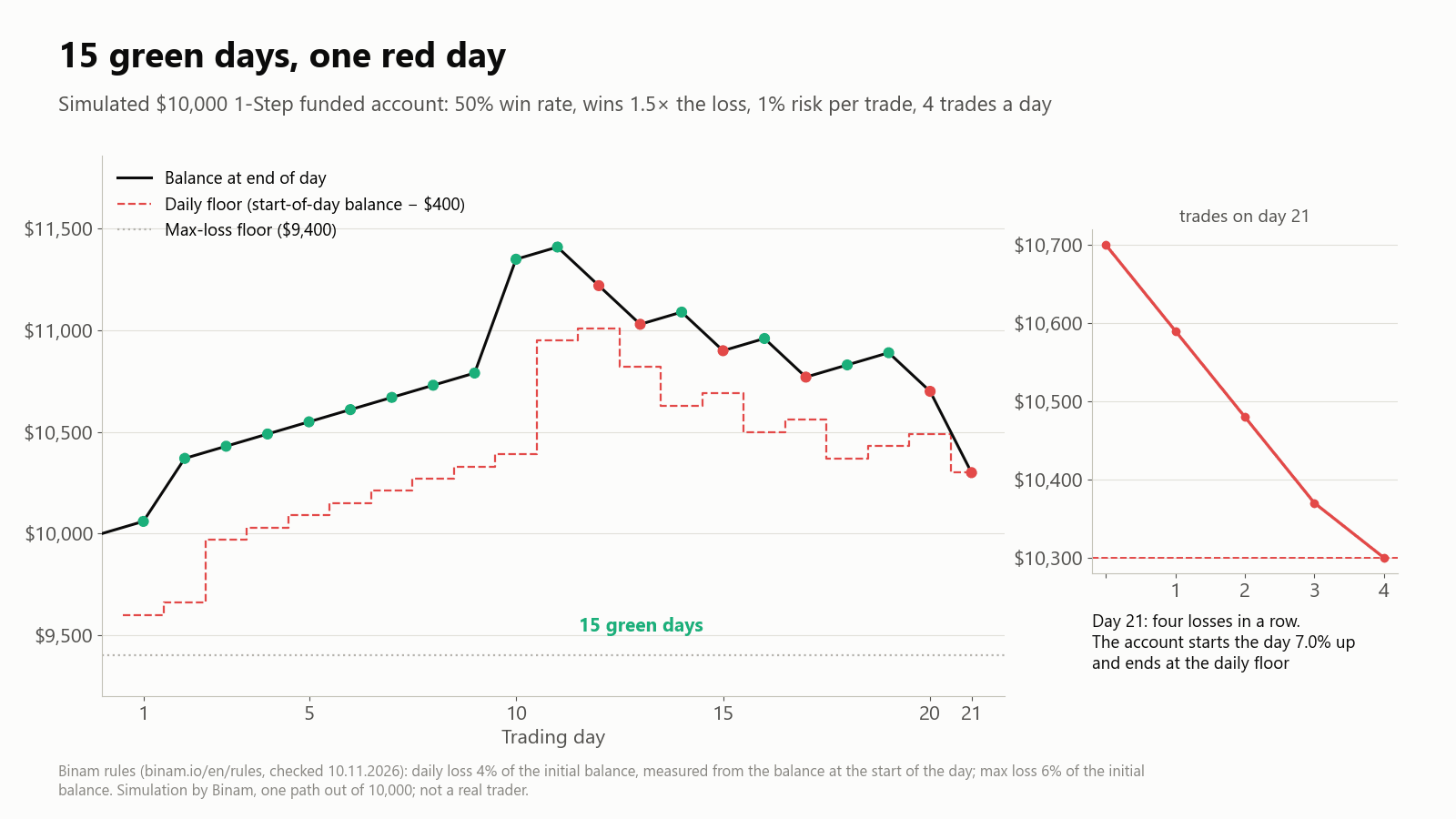
The account is up 7% on the morning of day 21. Here is that day:
| Trade | Balance before | Loss incl. costs | Balance after | Room to the $10,300 floor |
|---|---|---|---|---|
| 1 | $10,700 | −$110 | $10,590 | $290 |
| 2 | $10,590 | −$110 | $10,480 | $180 |
| 3 | $10,480 | −$110 | $10,370 | $70 |
| 4 | $10,370 | stop at −$110 never reached | $10,300 | $0, rule broken |
The fourth trade does not even need to hit its stop. The floating loss touches the floor first, and that is enough.
Across 10,000 runs of this trader on a funded account for 60 trading days, 91.5% of accounts were closed by the daily limit and 6.4% by the max loss. In 85.5% of the daily-limit closures the account was in profit at the start of the fatal day, by a median of 9.2%. A quarter of them had 15 or more green days before it. The plan made this almost certain: 4 trades of 1.1% each can add up to 4.4%, and a day with four losses in a row comes about once in 16 days at a 50% win rate.
How many losing trades can one day absorb?
Divide the daily limit by what one losing trade really costs. With a 4% limit and a 1% risk plus about 10% in fees and slippage, one loss costs 1.1%, so the day survives three losses and dies on the fourth. Any plan that allows more trades than that has a fatal day built into it.
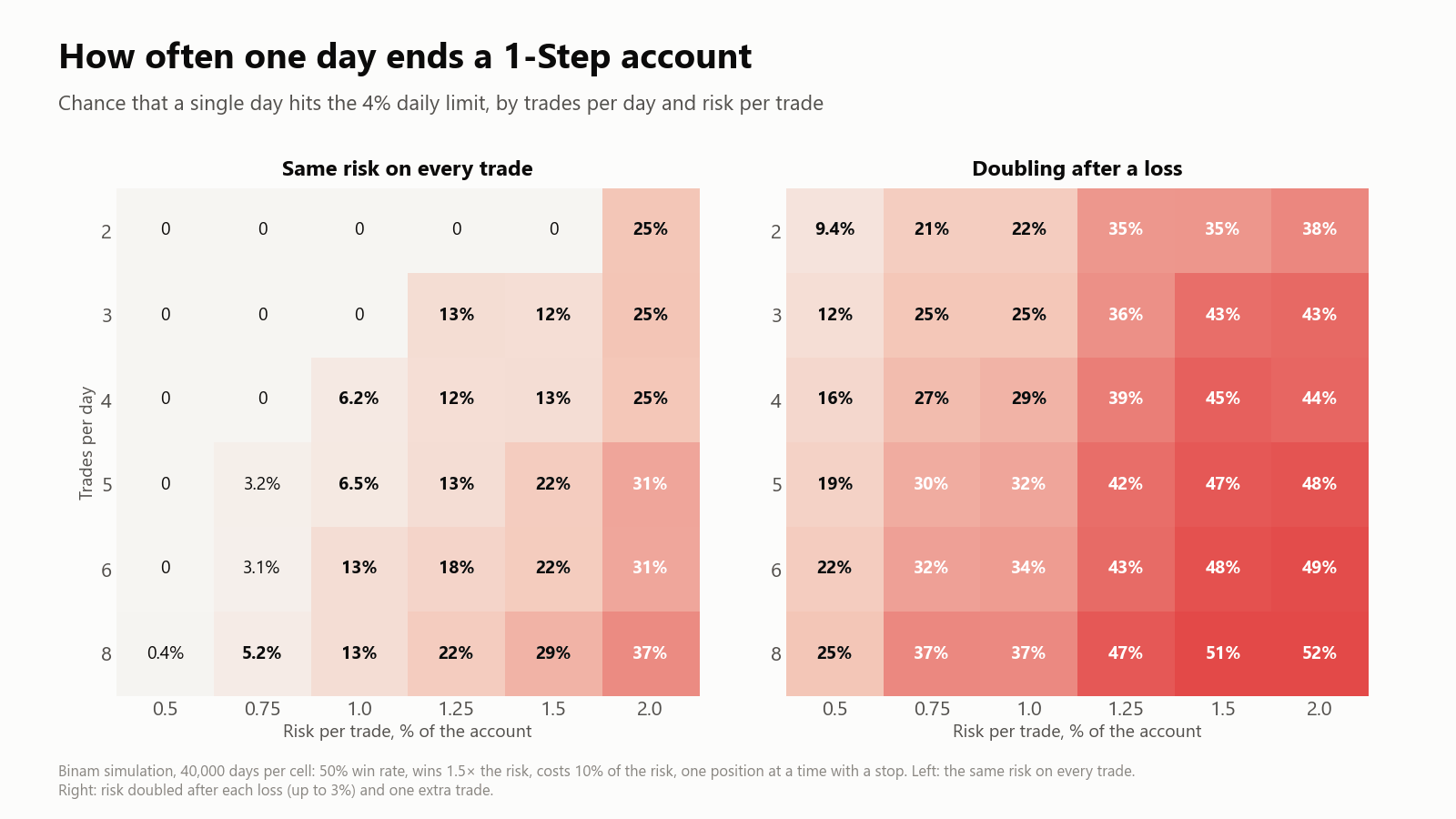
The left panel keeps the risk the same all day. As long as trades × loss per trade stays under 4%, the chance is zero: 4 trades at 0.75% can never break the rule. One step past that line, at 4 trades of 1%, the chance jumps to 6.2% a day.
The right panel is the same trader who doubles the size after each loss, up to Binam's 3% cap, and adds one more trade to win it back. With only 0.5% starting risk and 4 planned trades, 16% of days end the account. At 1% it is 29%. This is the pattern researchers found in professional futures traders: Chicago Board of Trade market makers with morning losses were about 16% more likely to take above-average risk in the afternoon (Coval and Shumway, 2005, Journal of Finance).
One Binam detail changes the arithmetic. A single position may not lose more than 3% of the initial balance; if its loss reaches 3%, the challenge fails (rule 5.1). So one trade cannot use up the whole 4% day by itself. A daily-limit failure on Binam is almost always two or more losing trades in the same day.
What does a 4% day look like on BTC, ETH and SOL?
It depends on leverage: 4% of the account is a 4% price move at 1×, 1.33% at 3×, 0.8% at 5× and 0.4% at 10×. We measured how often the market moved that far against a position opened at 00:00 UTC, using 738 days of Binance perpetual futures.
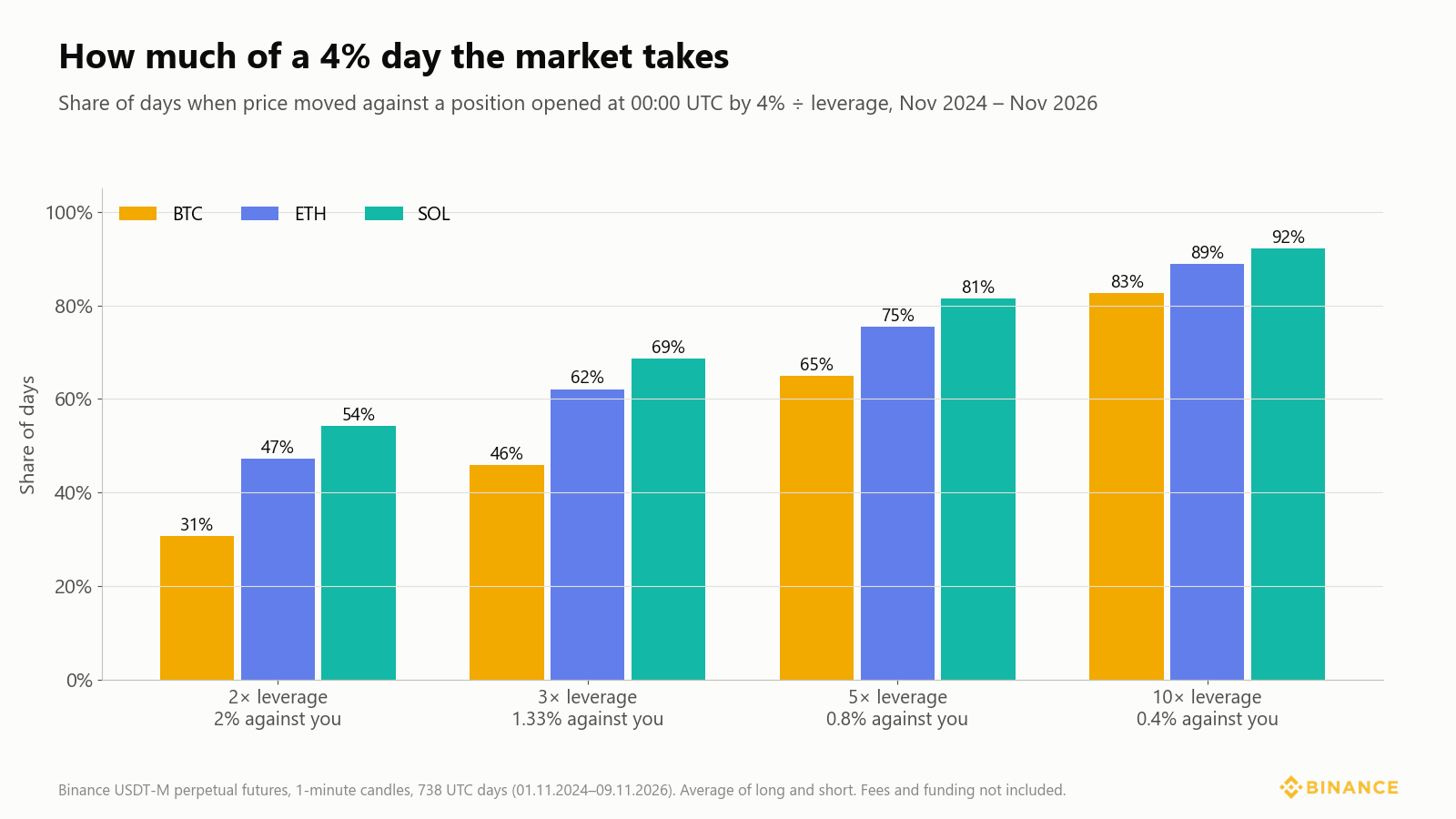
At 3×, BTC moved 1.33% against a position opened at the start of the UTC day on 46% of days, ETH on 62% and SOL on 69%. At 5×, the figures are 65%, 75% and 81%. These are moves at any point during the day, not closing prices. A position that would have ended the day flat still uses up the room if it dips first, because the daily drawdown counts floating losses.
The typical day is bigger than many traders assume. From November 2024 to November 2026, BTC's median high-low range for a UTC day was 2.98%, ETH's 4.62% and SOL's 5.40%. The range was 5% or more on 17.5% of BTC days, 42.7% of ETH days and 55.3% of SOL days.
The daily limit always comes before the exchange's liquidation. At 10× the liquidation price is roughly 9.5% away (how the liquidation price is calculated), while 4% of the account is gone after a 0.4% move. On a prop account, the daily floor is the risk to manage.
A recent example: on November 5, 2026, BTC opened the UTC day at $80,466 and traded as low as 6.6% below it. A long opened at the open with 5× leverage would have lost 4% of the account by 12:39 UTC, and at 3× by 14:14 UTC. The day before, the move went the other way: a 5× short from the open lost 4% by 05:50 UTC.
When does the daily drawdown reset on a 24/7 market?
There is no common clock. Each firm picks its own reset time, and on a market that never closes this choice decides which hours share one "day". At Binam the trading day starts at 00:00 UTC, and the daily drawdown is measured from the balance at that moment.
Here is how six other crypto prop firms set it, from their own rule pages checked on November 10, 2026:
| Firm | Daily limit | Limit sized from | Day measured from | Reset time | Open losses and fees |
|---|---|---|---|---|---|
| HyroTrader | 4% One-Step, 5% Two-Step, 3% Core and Instant | initial balance | equity at 00:00 UTC | 00:00 UTC | floating P&L and fees count |
| Kraken Prop | 3% | balance at 00:30 UTC | balance at 00:30 UTC | 00:30 UTC | unrealized losses, commissions and margin funding count |
| Crypto Fund Trader | 4% 1-Phase, 5% 2-Phase | not stated | balance at 00:05 UTC | 00:05 UTC | breaches measured on equity |
| Bitfunded | 4% 1-Step, 5% 2-Step, 3% 1-Step Express | "starting balance" | start of day | 00:00 UTC+8 (16:00 UTC) | realized plus floating loss |
| FTMO | 3% 1-Step, 5% 2-Step | initial capital | balance at 00:00 CE(S)T | 23:00 UTC in winter, 22:00 UTC in summer | equity incl. open P/L, swaps, commissions |
| FundedNext CFD | 5% Stellar 2-Step | initial balance | start of day, server time | 00:00 GMT+2/+3 (22:00 or 21:00 UTC) | open positions, swaps, commissions, fees count |
Two things in this table matter more than the percentage.
What the limit is sized from. At Binam, HyroTrader, FTMO and FundedNext the limit is a share of the initial balance, so its dollar size never grows. At Kraken Prop it is 3% of the balance at the reset, so after green days it grows a little: Kraken's own example gives a $9,700 floor for a $10,000 account.
Positions held through the reset. Every firm in the table tests the limit on equity, so a floating loss carried past the reset counts in full against the new day. FundedNext gives an example: a $6,000 floating loss held past midnight breaks a $5,000 limit on the new day. If you hold positions overnight, which Binam allows (rule 5.7), size them so that the open loss plus the next day's trades fit under one day's limit.
If your firm resets at 00:00 UTC, the new day starts at these local times:
| City | Winter (November to March) | Summer |
|---|---|---|
| New York | 19:00 the previous evening | 20:00 the previous evening |
| London | 00:00 | 01:00 |
| Dubai | 04:00 | 04:00 |
| Mumbai | 05:30 | 05:30 |
| Singapore | 08:00 | 08:00 |
When do crypto's biggest moves happen?
In US hours. On weekdays, BTC's average one-hour range peaks at the 14:00 UTC hour at about 1.25%, more than twice the quietest European-morning hours. In our data the widest hour of the day fell between 13:00 and 16:00 UTC on 39% of days.
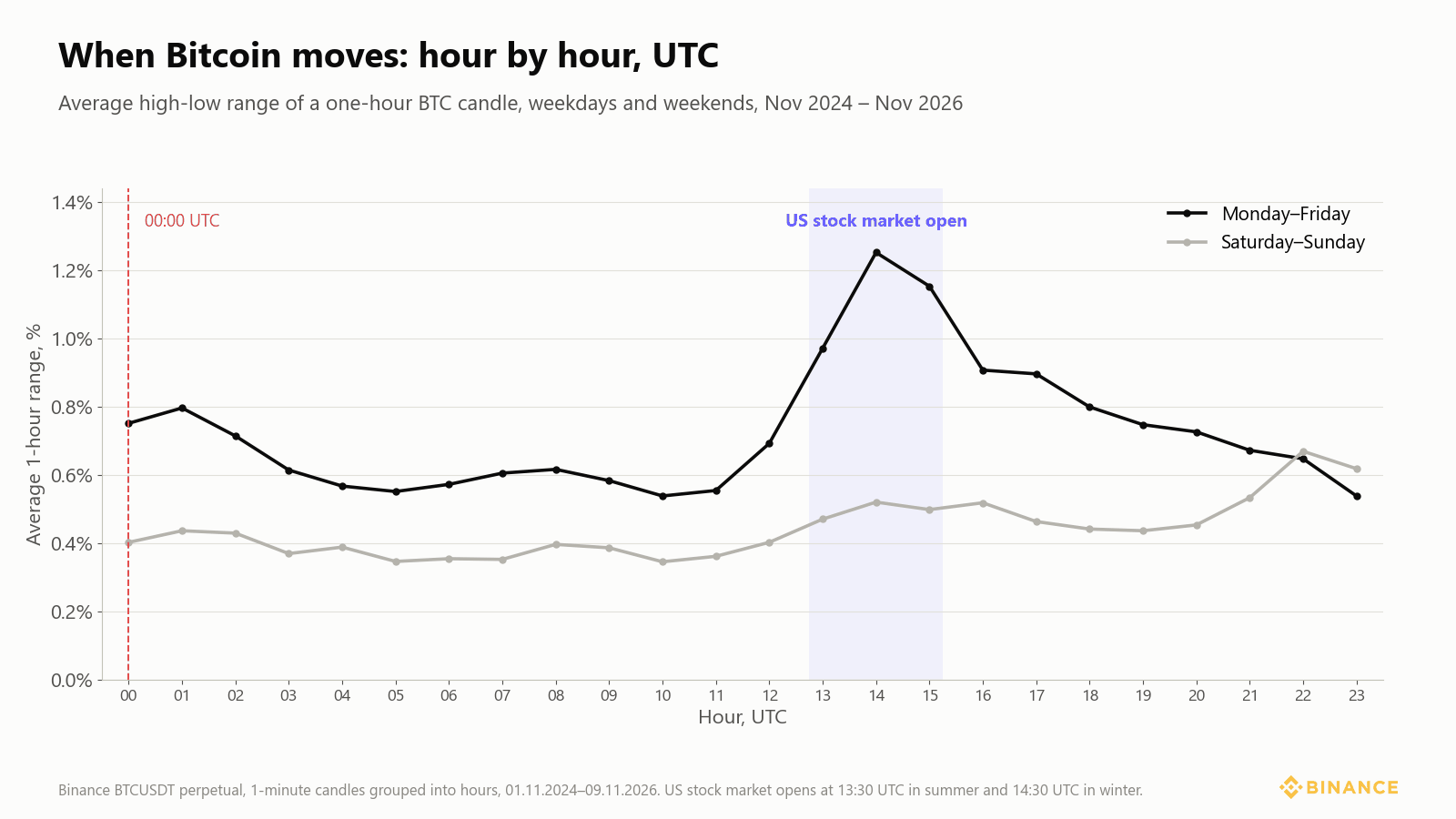
The US stock market opens at 14:30 UTC in winter and 13:30 UTC in summer, and US data releases come an hour earlier. The Fed's statements come later, at 19:00 UTC in winter: one 2026 study found BTC's average hourly move rising from 0.66% in the hour before an FOMC statement to 1.25% in the hour of it (Finance Research Letters, 2026). With a reset at 00:00 UTC, all of this falls in the second half of the trading day. A trader who loses in the Asian or European session meets the busiest hours already down.
Weekends are calmer but not off. BTC's median daily range was 1.84% on Saturdays and Sundays against 3.42% on weekdays, and only 5.7% of weekend days had a range of 5% or more. The exception is Sunday evening: the 22:00 UTC hour on Sundays averaged a 0.98% range, almost three times the same hour on Saturday, as the trading week reopens. We found no crypto prop firm that pauses the daily limit on weekends.
Big days come in clusters. After a BTC day in the top 10% by range (5.94% or more), the next day was also in the top 10% 29.7% of the time, against 7.8% after a normal day. ETH and SOL show the same pattern. After a wild day, the next one deserves a smaller size.
Do fees and funding count toward the daily loss?
Yes, at most firms: the limit is tested on equity, and fees reduce equity. Kraken Prop, HyroTrader, FTMO and FundedNext say so outright, and Kraken also counts margin funding charged on open positions.
On Binam the challenge runs on a demo account with real exchange commissions, so commissions are part of each trade's result. Funding is not charged on challenge accounts. On a $10,000 account at 5× leverage, a round trip with 0.05% taker fees on each side costs about $50, an eighth of a 4% day. Ten such trades take $500 before the market moves. If you trade often, count fees into the loss per trade, as we did above. More on how funding works on perpetuals is in our funding rate guide.
How do you stop one red day from ending the account?
Set your own daily stop well above the firm's floor and size every trade from it. In our simulation, the same trader who stopped for the day at −2% and never opened a trade whose stop could reach the floor never hit the daily limit. The 1-Step pass rate rose from 51% to 75%, and on the funded account 73% were still trading after 60 days, against 2%.
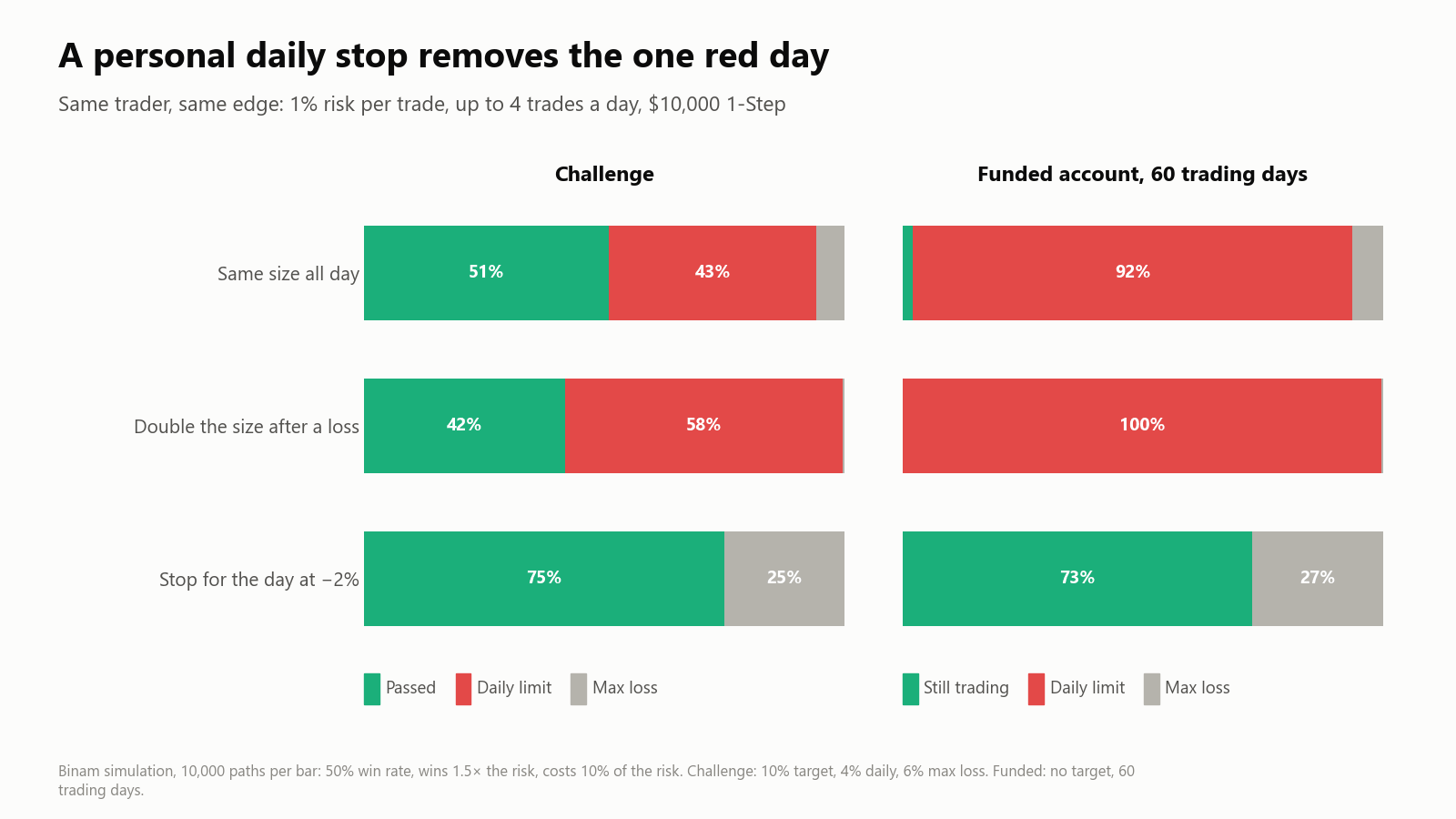
A personal stop does not make the edge bigger. With it, more of the remaining failures come from the max loss (25% of paths in the challenge). It turns one fatal day into a slower drawdown that you can see and stop.
A checklist that follows from the rules and the data:
- Write the floor down every morning. Start-of-day balance minus the limit in dollars. On a $10,000 1-Step account that is $400 under your opening balance.
- Set a personal stop at about half the limit. −2% on a 4% day, −2.5% on a 5% day. When you reach it, the day is over.
- Count your losing trades before the first trade. Personal stop ÷ (risk + costs). At 1% risk and 0.1% costs, two losses take you to the stop. Size down if you plan more trades.
- Do not raise the size after a loss. In our simulation, doubling after a loss turned a plan with zero chance of a fatal day (4 trades at 0.5%) into one that broke the limit on 16% of days.
- Check the room before each new trade. If the stop of the next trade could reach the floor, skip it.
- Size down for the US open and after a wide day. 13:00 to 16:00 UTC holds the widest hour on most days, and big days tend to follow big days.
- Close or shrink positions before the reset if they would start the new day deep in a loss. The open loss counts against tomorrow.
- If you run a bot, code the floor into it. Binam allows bots (rule 5.9), but the rules apply to them in full. Our test of AI agents on prop rules shows what happens without a risk layer.
How much evidence is there that daily stops help? Less than for the problem. We found no published study that compares traders with and without a daily limit on a real trading desk. Theory says a stop rule lowers expected return when prices move at random and helps when losses tend to continue (Kaminski and Lo, 2014), as they do after wide days in crypto. On the size of the problem, one prop-platform vendor reports that 54.2% of failed accounts in its data broke the daily loss limit (PropSim, week of November 9, 2026); it does not publish how many accounts or firms that covers.
Frequently asked questions
When does the daily drawdown reset at a crypto prop firm?
At a fixed time the firm chooses. At Binam the trading day starts at 00:00 UTC. Among other crypto firms, HyroTrader resets at 00:00 UTC, Crypto Fund Trader at 00:05 UTC, Kraken Prop at 00:30 UTC and Bitfunded at 00:00 UTC+8, which is 16:00 UTC. Check your firm's rules and convert the time to your own clock.
Is the daily loss limit based on balance or equity?
The day is measured from a balance or equity snapshot taken at the reset, and the loss is tested on equity, so open positions count. At Binam the starting point is the balance at the start of the trading day, and the floating loss on open positions counts toward the limit.
Do open positions count against the daily drawdown?
Yes. If the floating loss on open trades plus the day's closed losses reaches the limit, the rule is broken, even if the price comes back a minute later. A position held through the reset brings its open loss into the new day.
Does the daily limit apply on weekends?
Yes. Crypto trades every day, and crypto prop firms run the daily counter on Saturdays and Sundays too. Binam allows positions to be held overnight and over weekends, and open positions still count toward the daily drawdown.
Daily drawdown vs max drawdown: which ends more accounts?
The max drawdown is a fixed floor under the initial balance (6% on Binam's 1-Step). The daily drawdown resets every day from your current balance. Once an account is in profit, the daily floor is much closer than the max-loss floor, so the daily rule ends more profitable accounts. In our funded-account simulation of a trader taking 4 trades a day at 1% risk, it closed 91.5% of accounts within 60 trading days, against 6.4% for the max loss.
How much should I risk per trade with a 4% daily limit?
Little enough that your planned number of losing trades, with costs, stays under about half the limit. With a personal stop at 2% and 0.1% in costs per trade, that means about 1% per trade for two losers or 0.6% for three. Binam's own cap is 3% per trade; staying far below it is what keeps one day from ending the account. How to size a position shows the formula.
How we calculated
Market data. One-minute candles of Binance USDT-M perpetual futures for BTCUSDT, ETHUSDT and SOLUSDT from November 1, 2024 to November 9, 2026: 738 full UTC days, from Binance's public data archive. "Against a position opened at 00:00 UTC" means the largest move from the first-minute open of the UTC day to the day's low (for a long) or high (for a short). We report the average of long and short. Fees and funding are not included. Hour figures are the average high-low range of one-hour candles.
Simulation. Units are percent of the initial balance. Each trade wins with 50% probability; a win pays 1.5 times the risk, a loss costs the risk; costs are 10% of the risk on every trade. One position at a time, always with a stop. A losing trade breaks the daily or max-loss rule if the balance at its stop would be at or below the floor. Winning trades are assumed not to touch the floor first, which flatters every scenario equally. Challenge: Binam 1-Step rules as published on November 10, 2026, 10,000 paths per setting. Funded account: no target, 60 trading days. Per-day odds: 40,000 simulated days per cell. With a 45% win rate instead of 50%, the same trader passes the challenge 28% of the time with fixed size and 45% with a personal stop.
Competitor rules come from each firm's own pages on November 10, 2026 and may change.
What to do next
Before your next session, write three numbers on a sticky note: today's floor, your personal stop, and how many losing trades take you there. If you are choosing a challenge format, compare the 4% day of the 1-Step with the 5% day of the 2-Step in Binam's rules. Questions about the rules can go to the trader chat on Telegram.
Trading involves risk. This article is for information only and is not investment advice.