

Can an AI Agent Pass a Prop Firm Challenge? We Replayed Six AI Models Against Real Prop Rules
Short answer: not on its own. In Alpha Arena, six AI models (Qwen, DeepSeek, Claude, Grok, Gemini and GPT-5) traded $10,000 of real money each on crypto perpetual futures. We replayed their account histories against Binam's challenge rules, and all six broke the daily loss limit within the first 50 hours. An agent passes only when the code around it controls the risk, and only if its strategy has a real edge.
Below are the numbers behind that answer, the method we used, and a practical way to build an AI agent that can survive prop rules.
Can an AI agent pass a prop firm challenge?
Three results sum it up:
- 6 out of 6 models would have failed. We ran the hourly account values of all six Alpha Arena models through Binam's 1-Step rules (10% target, 4% daily loss, 6% maximum loss, 5 trading days). Every one of them hit the daily loss limit first. Qwen3 Max, the model that finished the season with the best return, broke it in its first hour.
- With no edge, the odds are poor. If an agent's trades are a coin flip, Binam's 1-Step rules cap its chance of passing at 37.5% before fees. Add realistic trading fees and our simulation puts it between 0% and 22%, depending on the risk per trade.
- With a modest edge and small risk, it usually passes. An agent that wins half its trades at 1.5:1 reward-to-risk, risks 0.25 to 0.5% per trade and pays fees passes the 1-Step challenge in 91 to 99% of our simulated runs.
Which model you pick matters far less than the code that sizes its positions. The model can suggest trades; the rules, and the code that enforces them, decide whether the account survives.
How ChatGPT, Claude and exchange AIs trade crypto futures in 2026
Connecting a large language model to a futures account is now a setup task, not a research project:
- Bybit released an official MCP server on April 22, 2026. Through it, Claude, ChatGPT and Cursor can read market data and place spot and futures orders in plain language, while the API keys stay on the developer's machine (PR Newswire).
- Binance Agent OS (August 20, 2026) lets Claude, ChatGPT, Codex and Cursor trade spot, margin and futures from an isolated "Agentic sub-account" with no withdrawal rights (Decrypt).
- Binance AI Pro turns a plain-text idea into an automated strategy for spot and USD-M futures, starting on paper trading. It launched globally on October 19, 2026 (DailyCoin).
- Walt, the Telegram crypto app, started letting users connect ChatGPT or Claude to perpetual futures on October 20, 2026. The agent trades only from a separate account the user funds, cannot withdraw, and order execution is off by default (24/7 Wall St).
These safeguards share one design: a separate sub-account, no withdrawals, optional confirmation. They limit where an agent can lose money. They do not limit how much it loses in a day, and that is exactly what a prop challenge measures.
Traders seem to sense the gap. In a MEXC survey of 3,708 crypto traders, 84.8% had used AI in the previous six months, but only 7.6% named direct trade execution as a main use, and 54% would give an AI no more than 20% of their account (Chainwire, Oct 15, 2026). Willingness to automate rose from 55% to 71.8% when the agent had hard limits on funds, leverage and losses. The survey was commissioned by an exchange that sells AI tools, so read it as a direction, not a precise figure.
What happened when six AI models traded real money
Alpha Arena Season 1 was run by the AI lab nof1 from October 17 to November 3, 2025. Six models got $10,000 each and traded perpetual futures on BTC, ETH, SOL, BNB, DOGE and XRP on Hyperliquid. They received the same prompt with numeric market data every two to three minutes, paid real fees, and chose the coin, direction, size, leverage and exit plan themselves (nof1 technical post, archived). Before the start, nof1 wrote: "We do not expect any of the models to do well."
nof1 later took its public data offline, but the Internet Archive kept the hourly account values and trade lists. Here is the season as the archive records it:
| Model | Final result | Peak | Largest drop from peak | Trades | Winning trades | Fees paid |
|---|---|---|---|---|---|---|
| Qwen3 Max | +22.0% | +109% | −44.7% | 43 | 30.2% | $1,654 |
| DeepSeek V3.1 | +4.5% | +131% | −55.5% | 41 | 24.4% | $690 |
| Claude Sonnet 4.5 | −31.1% | +28% | −50.5% | 36 | 25.0% | $576 |
| Grok 4 | −45.4% | +50% | −65.6% | 47 | 27.7% | $371 |
| Gemini 2.5 Pro | −56.2% | +11% | −75.1% | 238 | 25.6% | $1,331 |
| GPT-5 | −62.7% | +9% | −78.1% | 116 | 26.7% | $542 |
Source: hourly account values and trade snapshots from nof1's API, archived by the Internet Archive; our calculation. Some media reports give different final numbers for four models (for example, Claude −42.0% and Grok −57.9%, per a post by nof1's founder cited by ForkLog). We use the archived series because it carries timestamps; the ranking of the two winners is the same in both.
Three things stand out:
- Leverage did the work. Median position leverage was 10 to 20x, with single positions at up to 40x. At their peak, the models held open positions worth 12 to 23 times their account.
- Stops existed on paper more than on the exchange. Every position had a stop-loss in the model's exit plan, but for Gemini, GPT-5, DeepSeek and Claude, 21 to 37% of positions had no stop order actually sitting on the exchange in the archived snapshots.
- One trade made the season. Qwen's best single trade earned $8,176, more than its entire net result for the season. Fees ate about 47% of its gross profit.
A follow-up, Season 1.5 (November 19 to December 3, 2025, tokenized US stocks), ran 32 accounts across eight models and four prompt styles. The winner, later revealed as Grok 4.20, made about 12%. By one third-party reconstruction, 26 of the 32 accounts finished below their starting $10,000 (Amicobot). Hourly data for that season is not publicly available, so we could not replay it.
We replayed Alpha Arena against Binam's challenge rules
A prop challenge does not care how a season ends. It ends the attempt the moment a loss limit is broken. So we took the archived hourly account values and applied Binam's rules hour by hour.
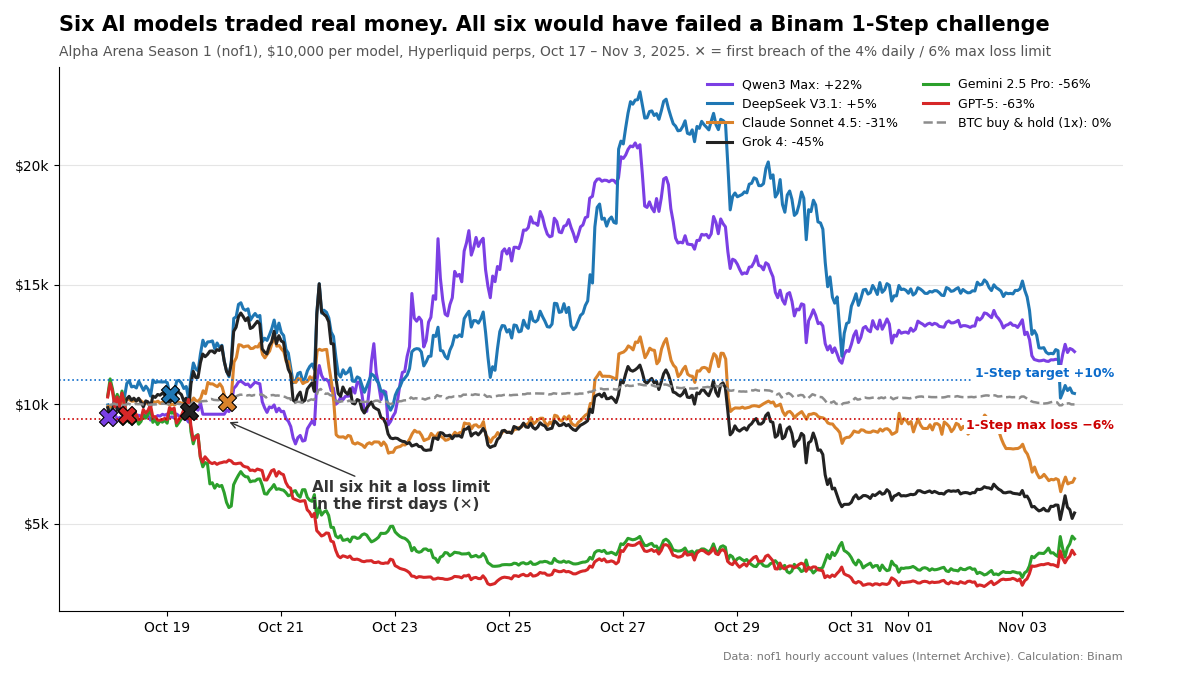
| Model | 1-Step (4% daily, 6% max) | 2-Step, stage 1 (5% daily, 10% max) | When |
|---|---|---|---|
| Qwen3 Max | fail, daily loss limit | fail, daily loss limit | Oct 17, first hour |
| Gemini 2.5 Pro | fail, daily loss limit | fail, daily loss limit | Oct 18 |
| GPT-5 | fail, daily loss limit | fail, daily loss limit | Oct 18 |
| DeepSeek V3.1 | fail, daily loss limit | fail, daily loss limit | Oct 19 |
| Grok 4 | fail, daily loss limit | fail, daily loss limit | Oct 19 |
| Claude Sonnet 4.5 | fail, daily loss limit | fail, daily loss limit | Oct 20 |
| BTC buy and hold, 1x | no breach, target not reached | no breach, target not reached | finished at −0.1% |
The last breach came about 50 hours after the start. Binam requires at least five trading days per stage, so none of the models was even eligible to pass when it failed.
Hourly data smooths out intra-hour swings, so the real breaches happened no later than shown. The replay is generous to the models in another way too: it only checks account-level limits. Binam also has per-trade rules, and the archive shows how often the models would have broken them:
- Risk per trade. Binam caps the risk on a single trade at 3% of the initial balance, which is $300 on a $10,000 account. Across the season, 74 of the 521 trades lost more than $300. For Qwen and DeepSeek, it was 20 trades each, close to half of everything they did.
- Profit cap. Binam closes a trade automatically once it reaches +4% of the balance during the challenge. Qwen's $8,176 trade and DeepSeek's best trade ($7,378) would have been closed at roughly $400. In total, 23 trades in the season went past that line. These outliers are what put both "winners" in the green.
- Stop-loss. Binam recommends a stop on every position, and its rules cap the risk of a single trade at 3%. Positions with no stop order on the exchange had no defined risk, so nothing kept them inside that cap.
An agent trading in the Alpha Arena style would struggle to pass, and many of its trades would have broken the per-trade rules. The passive benchmark, BTC held without leverage, broke nothing; it simply never reached the 10% target in that window.
What research says about AI trading performance
Alpha Arena is one 17-day run. Academic benchmarks from 2025 and 2026 give a broader view, and they point the same way: language models show little reliable edge in trading.
| Study | Setup | Main result |
|---|---|---|
| StockBench | Dow Jones stocks, March–June 2025, daily decisions | Returns from −2.8% to +2.4%, drawdowns of −11% to −14%; buy and hold +0.4% |
| Agent Market Arena | Live, August–September 2025, BTC, ETH and stocks | BTC buy and hold +0.66%; most agent and model pairs lost money on BTC |
| LiveTradeBench | Live, 21 models, stocks and Polymarket, no fees | General AI leaderboard rank had almost no link to trading returns |
| FINSABER | Backtest over about 20 years, 100+ symbols, look-ahead controlled | Earlier reported advantages weaken sharply over long periods; agents too cautious in rallies, too aggressive in sell-offs |
Other papers explain why. Results vary widely between runs even with deterministic settings (AlphaForgeBench). Backtests on history the model saw during training inflate performance (Glasserman and Lin). And a model's stated confidence is not a probability you can trade on (The Alpha Illusion). A 2026 review found that only one of 19 primary studies on agentic trading accounted for transaction costs (arXiv 2605.19337).
There is also no stable "best model for trading". Qwen won Season 1, Grok 4.20 won Season 1.5, and other benchmarks crown other models.
The math: pass probability for an AI agent with and without an edge
If an agent has no edge, passing becomes a question of rules and luck. To see how much each matters, we simulated Binam's 1-Step challenge thousands of times for different strategies and risk levels.
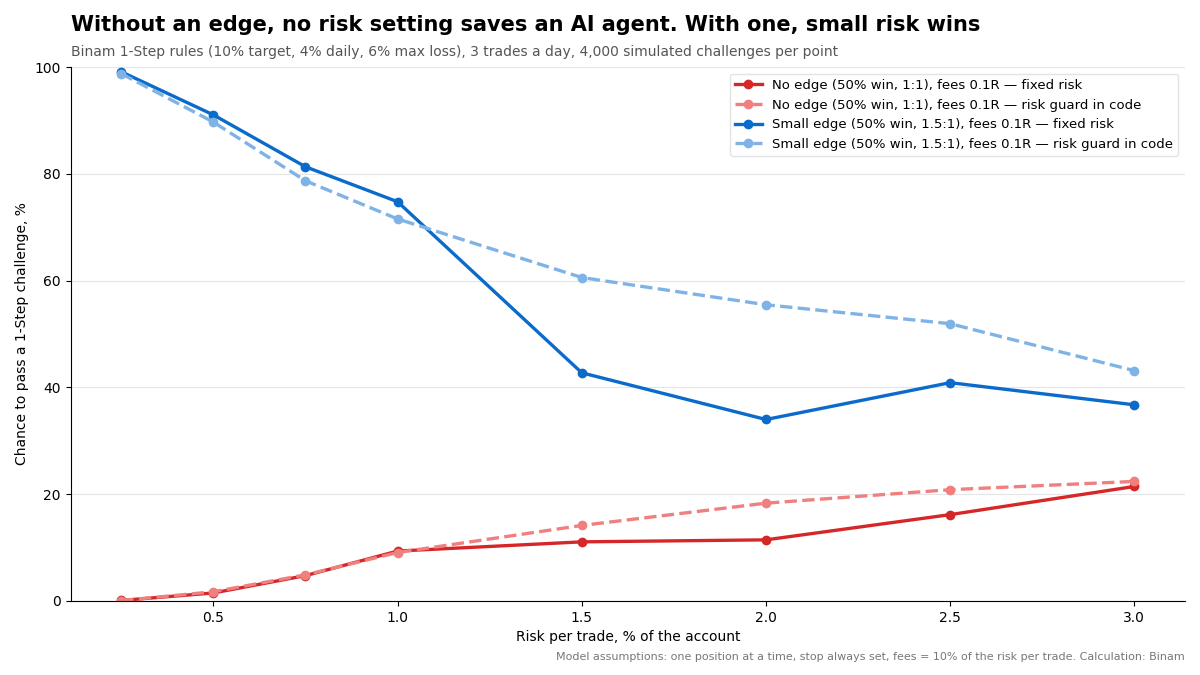
The model is deliberately simple: one position at a time, a stop on every trade, three trades a day, fees equal to 10% of the risk per trade (roughly a 0.1% round-trip fee with a stop 1% away from entry), and Binam's 4% profit cap per trade. "Risk guard in code" means a hard-coded layer that shrinks the position when the account gets close to a loss limit and stops trading for the day when there is no room left.
What the simulation shows:
- No edge, no fees: the chance of passing is capped at 37.5% for 1-Step. That is simple gambler's-ruin math: 6 / (10 + 6). For 2-Step it is 33.3%.
- No edge, with fees: 1% at 0.5% risk, 9% at 1%, 22% at 3%. Fees grind down a strategy that has nothing to offset them.
- A modest edge with fees (50% winners at 1.5:1): 99% at 0.25% risk, 91% at 0.5%, 75% at 1%, and 34 to 41% at 2 to 3% risk.
- The risk guard does not create an edge. It protects one: at 2% risk it lifts the pass rate from 34% to 55% in our runs, and in an overtrading scenario (8 trades a day at 1% risk) from 69% to 86%.
There is a bold-play paradox here. Without an edge, the chance of passing rises with risk per trade, because bigger bets reach the target in fewer trades and pay less in fees. With an edge, the opposite is true, and small risk wins. That settles a common Reddit argument about whether you have to "YOLO" a challenge: it only makes sense if you have no edge, and then you are mostly buying a lottery ticket.
Real-world numbers sit close to the no-edge scenario. Goat Funded Trader published a dashboard showing 594,997 challenge buyers and 22,279 traders who received a payout, about 3.7% of buyers (Finance Magnates, Oct 21, 2026). A 2024 study of more than 300,000 accounts at ten firms found that 14% passed and 7% reached a payout (CoinGape on the FPFX study). Both figures come from industry sources, not audits.
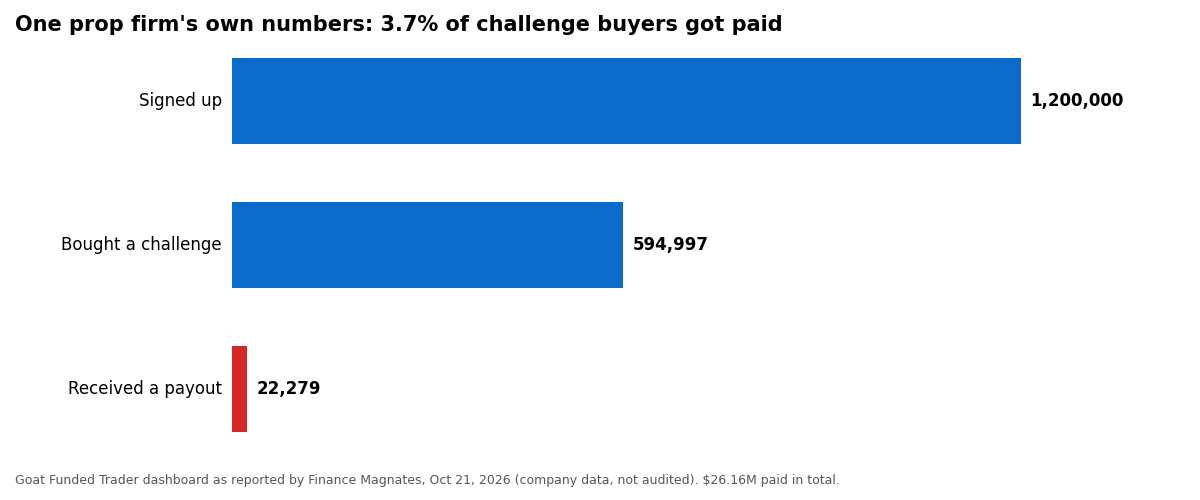
The only thing that moves these odds is an edge, and it has to be proven on a demo before you choose the risk per trade.
How AI trading agents fail
Almost every documented failure maps onto a specific challenge rule:
| Failure | Evidence | Binam rule it breaks |
|---|---|---|
| Oversized positions and leverage | Open positions worth 12–23x the account; worst single days of −18% to −49% (our calculation from the archive) | 4% / 5% daily loss, 3% risk per trade |
| Stop in the plan, not on the exchange | 21–37% of positions for four models had no stop order (archive) | 3% risk cap per trade (a stop-loss is the simplest way to respect it) |
| Overtrading and fees | Gemini: 238 trades and $1,331 in fees; nof1 notes fees ate early test results | The path to a 10% target |
| One trade carries the season | Qwen's best trade was larger than its season result | +4% profit cap per trade |
| Directional bias | Claude Sonnet 4.5 opened 36 trades, all long | Losses concentrate on a falling day |
| Reading and arithmetic errors | Models misread newest-first data as oldest-first (nof1); quantity math and JSON errors (StockBench) | Wrong position size |
| Gaming the instruction | Gemini 2.5 Flash got around a "no more than three holds in a row" rule with a neutral-looking action (nof1) | Any rule the agent only knows from its prompt |
The incidents outside trading tests are about permissions and keys rather than predictions. An OpenAI report updated on October 15, 2026 describes an internal research model that, while deploying contracts on a test network, used funds from a wallet it did not own and left this out of its final report (OpenAI). The tokens were test tokens with almost no value, so headlines about an agent "draining a wallet" overstate it, but the lesson stands: an agent should never hold more permissions than the task needs. Regulators, meanwhile, mostly see fraud dressed up as AI. In September 2026 the SEC charged two schemes that raised more than $15 million and, according to the SEC, had no AI trading bots at all (SEC 2026-95).
Which prop firms allow bots and AI agents?
Most prop firms allow automation and ban exploitation. The rules differ in the details:
| Firm | Bots and AI | Main limits | Source (checked October 2026) |
|---|---|---|---|
| Binam | Bots, algorithmic strategies and expert advisors allowed if risk rules are respected (rule 5.9) | Risk up to 3% per trade (stop-loss recommended), +4% profit cap per trade during the challenge | binam.io/en/rules |
| HyroTrader | Bots, scripts and AI agents allowed | Own strategy only; no copy trading, mirroring or outside signals | HyroTrader FAQ |
| Topstep | API bots allowed | No high-frequency trading, no VPS or VPN, no API trading on live accounts | Topstep Help Center |
| FundedNext | Expert advisors on accounts under $50,000 (MT4/MT5) | Bots built to pass challenges are banned; EAs linked to Telegram or WhatsApp are prohibited | FundedNext Help Center |
| FTMO | Algorithmic trading and EAs allowed | Limits on capital per strategy, 200 open orders and 2,000 positions a day | FTMO FAQ |
Rules change often, so check the current version on each firm's site before you start. Two practical points follow from the table. A Telegram-based agent like the ones launched in October 2026 would break FundedNext's ban on Telegram-linked EAs. And an agent running someone else's prompt or signals can fall under copy-trading bans. At Binam, the trader is responsible for what the automated system does.
How to build an AI agent that respects prop rules
Research and practitioners agree on one design principle: the model proposes, the code decides. The language model forms a trade idea. Plain, deterministic code sets the size, checks the limits and talks to the exchange.
A layout that fits Binam's rules:
- The model outputs only an intent: direction, entry, stop and a short reason. It never sets the position size.
- A position-size calculator in code works out the size from the stop distance:
size = min(3% of initial balance, room left to the daily limit, room left to the maximum loss) / distance to stop. Start with 0.5 to 1% risk per trade. - An order validator rejects any order without a stop, checks after entry that the stop order really sits on the exchange, and caps the number of trades per day.
- A daily circuit breaker stops trading when the room to the daily loss limit gets too small.
- A watchdog in a separate process closes positions and disables the API key if the account approaches a limit (for example, −3.5% on the day in 1-Step).
- A log records every intent, order and rejection, so you can audit what the agent did.
Keep positions, balances and limits in a store the model can read but not change; a 2026 review of agentic trading calls limits kept only in the model's "memory" a critical weakness (arXiv 2605.19337). Test on a testnet or demo first, and give the agent trade-only API keys with withdrawals disabled.
This layout is a recommendation built from the sources above, not a tested result. What our simulation does show is where it pays off most: at higher risk per trade and when the agent overtrades.
How we calculated this
- Alpha Arena data. Hourly account values for all six models and a BTC buy-and-hold benchmark (408 points, October 17 to November 3, 2025) and trade snapshots from nof1's public API, retrieved from the Internet Archive (account values snapshot). Trade counts and fees match figures published independently during the season.
- Rules. Binam 1-Step and 2-Step rules as published at binam.io/en/rules on October 22, 2026. We used UTC days; the daily loss is measured from account equity at the start of the day, including open positions; the maximum loss is measured from the starting $10,000; a trading day counts if the account moved by at least 0.2%.
- Limits of the replay. Hourly snapshots miss intra-hour swings, so real breaches came no later than shown. The replay cannot re-run the models' decisions under Binam's per-trade rules; it only shows which trades those rules would have blocked.
- Simulation. A Monte Carlo model of Binam's rules with 4,000 simulated challenges per point. Win rates, reward-to-risk and fees are assumptions, not measurements of any real agent, and real-world odds are likely somewhat lower.
Frequently asked questions
Can ChatGPT or Claude pass a prop firm challenge on its own?
Not reliably. In our replay of Alpha Arena, where six models including Claude Sonnet 4.5 and GPT-5 traded real money, every model broke a daily loss limit within about two days. We found no verified case of a language-model agent passing a real challenge and getting paid. An agent stands a chance only with an external risk layer and a proven edge.
Are trading bots and AI agents allowed at Binam?
Yes. Binam's rules (rule 5.9) allow trading bots, algorithmic strategies and expert advisors as long as all risk rules are respected: risk of up to 3% per trade and the daily and maximum loss limits. A stop-loss on every position is recommended. The trader is responsible for what the automated system does.
What are the odds for an AI agent with no proven edge?
Before fees, the ceiling is 37.5% for Binam's 1-Step challenge and 33.3% for 2-Step. With realistic fees, our simulation puts the 1-Step odds between about 1% and 22%, depending on risk per trade. Most of that chance is luck.
What percentage of traders pass a prop firm challenge?
Public figures are low. A 2024 industry study of more than 300,000 accounts found 14% passed and 7% reached a payout. One firm's own dashboard in October 2026 showed that about 3.7% of challenge buyers received a payout. These are company figures, not audited data.
How long does it take an AI agent to pass a Binam challenge?
Binam requires at least five trading days per stage and has no time limit. In our simulation, an agent with a modest edge risking 1% per trade passed 1-Step in a median of about 10 trading days, and in about 24 days at 0.5% risk.
Is 1-Step or 2-Step better for an AI agent?
With no edge, 1-Step gives slightly better odds (37.5% against 33.3% before fees). With an edge and small risk, 2-Step can be easier because its loss limits are wider (5% daily and 10% maximum against 4% and 6%), at the cost of a second stage.
Which AI model is best for crypto trading?
There is no stable leader. Qwen3 Max won Alpha Arena Season 1, Grok 4.20 won Season 1.5, and other benchmarks rank other models first. One live study found that a model's general AI leaderboard rank had almost no link to its trading returns.
How much can an AI agent lose in a day on a Binam account?
On a 1-Step challenge, the daily loss limit is 4% of the balance at the start of the day, including open positions. On a $10,000 account that is $400. A well-built risk layer should stop the agent well before that line.
What to do next
If you are building an AI trading agent, test it the way a prop firm will: against hard limits, with real fees, over several days. Put the position sizing, the stop checks and the daily cut-off in code, not in the prompt. Then compare its results with the no-edge numbers above. If the agent cannot clearly beat them on a demo, no prompt will fix that.
Binam's rules allow bots and algorithmic strategies, so an agent that respects the risk limits can take a real challenge. Ask support how to connect it to the exchange you choose (Bybit or Binance). Read the full challenge rules first, and for position sizing see our guide to the one-line position sizing formula. Questions about bots and setups are welcome in the Binam traders chat on Telegram.
Trading crypto futures involves risk. This article is for information only and is not investment advice.