

An Exchange Can Leave in Five Days: What the Bitget and MEXC Exits Teach Crypto Futures Traders
Short answer: when a crypto exchange stops serving your country, it decides the timeline, and the timeline is getting shorter. In October 2026, Bitget went from a rule change to forced closure of positions in five days. We collected 30 exchange exits since 2019: before 2024, traders usually had about a month before new positions were blocked. Since 2024, the median is four days.
This article walks through what happened with Bitget and MEXC, what the 30 cases show about open positions and leftover balances, and how a futures trader can limit platform risk without waiting for the next notice.
What happened with Bitget and MEXC in October 2026
Two large offshore exchanges announced restrictions for users from Russia and neighbouring countries within one week:
| Bitget | MEXC | |
|---|---|---|
| Countries | Russia, Belarus, Kazakhstan | Russia, Belarus |
| Announced | October 16, 2026 (terms of use updated) | October 20, 2026 |
| No new orders or positions | October 18, 10:00 Moscow time | October 24, 00:00 Moscow time |
| Trading stops / positions closed | October 21, 10:00 Moscow time (forced closure) | October 28, 00:00 Moscow time |
| Withdrawal deadline | October 21, 10:00 Moscow time | November 4, 00:00 Moscow time; after that, only through support |
| How users were told | Personal notices | Public announcement, dates in personal notices |
Sources: Vedomosti, Kommersant, CoinEdition for Bitget; MEXC announcement and Cointelegraph for MEXC. MEXC dates are from a typical personal notice; individual timelines may differ.
Two details matter more than the dates. First, both exits were selective: each user got a personal notice, so the real notice period depended on when that email was read. Bitget's press service called it a one-off measure that affects only certain users. Second, both exchanges kept the right to act on their own after the deadline. Bitget's terms allow it to close positions, restrict withdrawals and convert assets; MEXC moves late withdrawals to a support queue with fees and minimum amounts.
Neither exchange gave an official reason. Industry commentators linked Bitget's move to its application for a European licence under the MiCA regulation.
30 exchange exits since 2019: how much notice traders got
To see whether five days is unusual, we collected 30 cases from 2019 to October 2026 in which an exchange stopped serving residents of a country or region. They include Binance in the Netherlands, Canada and Russia, Bybit in the UK, Canada and France, OKX and Gate in Hong Kong, Kraken and Coinbase in Japan, and the two October 2026 cases. For 18 of them, the date when new positions or trading were blocked is clear.
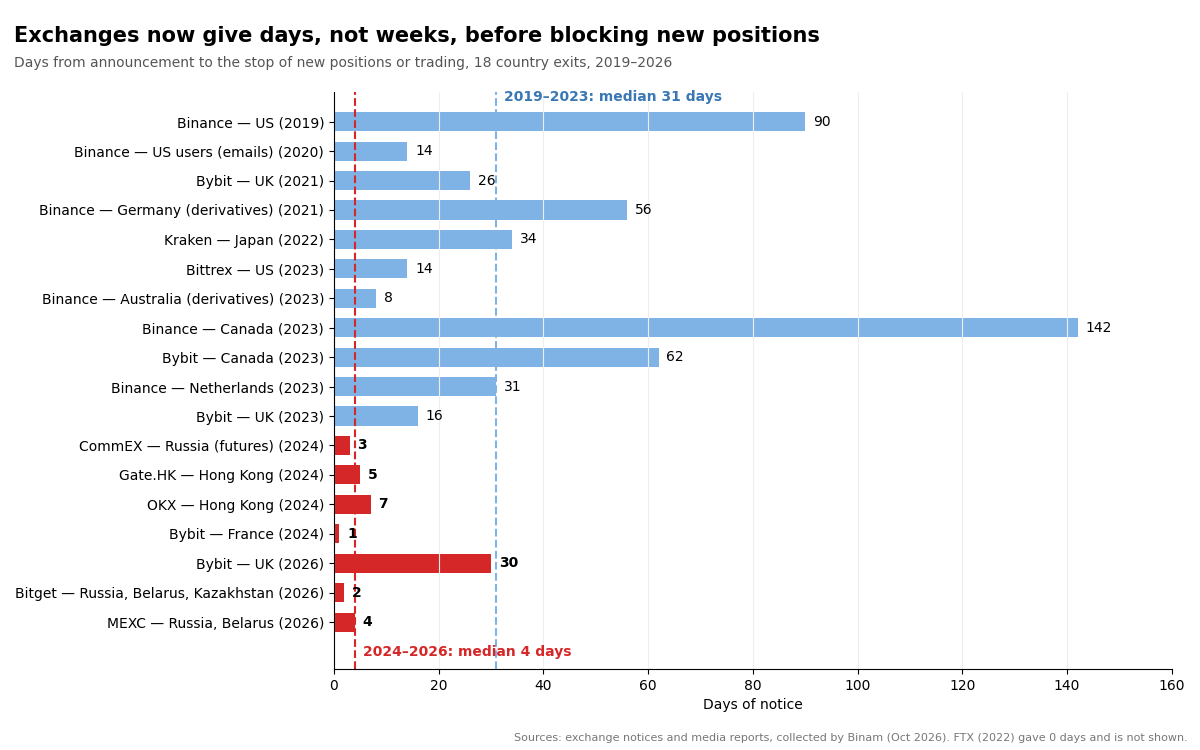
The pattern is hard to miss:
- 2019–2023: the median notice before new positions were blocked was 31 days (11 exits, from 8 to 142 days).
- 2024–2026: the median was 4 days (7 exits, from 1 to 30 days).
- The shortest cases are recent. Bybit switched French users to close-only mode one day after its announcement in August 2024. Bitget stopped new orders after two days, CommEX stopped futures after three, MEXC blocked new positions after four.
- The full cycle can be very short. Bitget's five days from rule change to forced closure is the shortest complete exit in our set.
The sample is small and the cases differ, but the direction is clear. Older exits were often planned months ahead around a new law. Recent ones tend to follow a licensing decision, a regulator's deadline or a sanctions risk, and users get days.
One case shows the other extreme. FTX in November 2022 was not an exit but a collapse: withdrawals effectively stopped with no notice while the company said publicly that they were open, and all balances became bankruptcy claims (The Block timeline).
What happens to open futures positions when an exchange leaves
Across the cases, open futures positions were never carried over. The sequence repeats:
- Close-only mode. You can reduce or close positions and add margin, but you cannot open new ones or increase existing ones.
- Forced closure on a fixed date. Whatever is still open gets liquidated or "settled at market value" by the exchange.
In the seven cases with a firm closure date, the median time from announcement to forced closure was 15 days. The four offshore cases from 2023 to 2026 sit between 5 and 15 days: Bitget 5, MEXC 8, Bybit France 12, Binance Australia derivatives 15.
A forced closure is not the same as closing a trade yourself:
- You do not choose the moment. The position is closed at the market price at the exchange's time, which can be the worst point of a volatile day.
- Thin markets get worse fills. Many users of the same country close at once, often in the same pairs.
- Hedges break. If a position hedges something elsewhere, closing one leg on someone else's schedule leaves the other side exposed.
For a futures trader, the practical takeaway is simple: in close-only mode, the only decision left is when to close before the exchange does it for you.
What happens to your balance after the deadline
Leftover balances in our cases were rarely lost outright, but they became harder and more expensive to reach:
| What happened to leftover funds | Example |
|---|---|
| Converted to local currency and deposited with a state body | Kraken and Coinbase, Japan (2023) |
| Converted to USDC and moved to a local custodian; a 10 USDC fee or closure for small balances | Bybit, France (2024–2025) |
| Converted at a fixed rate | Binance, Nigeria, naira to USDT (2024) |
| Treated as unclaimed property after the closure date | OKX, Hong Kong (2024) |
| Withdrawal only through support, with fees and minimums | MEXC, Russia and Belarus (2026) |
| Account locked if funds were not withdrawn | Binance emails to US users (2020) |
Withdrawals usually stay open longer than trading. Among 15 cases with a firm withdrawal deadline, the median was 30 days. At least six exits set no deadline at all and simply left withdrawals open, as Bybit did for UK users in 2023 and again in 2026. The rushed exceptions were Binance's naira cut-off in Nigeria (about 3 days), Bitget (5 days), Binance's emails to US users in 2020 (14 days) and MEXC (15 days).
Why exchanges leave: regulation, not insolvency
In 23 of the 29 exits in our set, the stated reason was regulation, licensing, compliance or sanctions. Two cited market conditions (Kraken and Coinbase in Japan), and four gave no clear reason. Typical triggers:
- A new licensing regime. Binance left the Netherlands in 2023 after failing to obtain registration with the Dutch central bank. OKX and Gate's Hong Kong affiliate withdrew their licence applications in 2024 and closed within days.
- Derivatives rules. UK retail crypto derivatives were banned in 2021; new Canadian rules for crypto trading platforms pushed Bybit and Binance out in 2023.
- A regulator's block. In 2025 Thailand's securities regulator gave users of five unlicensed exchanges 30 days before blocking access.
- Sanctions and licence ambitions elsewhere. An exchange applying for a licence in one region may cut users from another.
None of this says anything about the quality of a particular exchange. A well-run platform can still leave your country because of a decision made far away. Exchange stability and platform availability are different risks: during the Bybit hack in February 2025, for example, withdrawals kept running (Cointelegraph), while a perfectly solvent exchange can close a country in five days.
How futures traders can reduce platform risk
You cannot control an exchange's licence decisions. You can control how exposed you are when one happens:
- Read official notices, and only official notices. Check announcements in the app and on the exchange's site. Exit waves attract phishing emails "from the exchange" that ask users to confirm details or move funds. Use your saved address for the site and never a link from an email.
- Keep only working margin on a trading account. Funds you are not using for open positions do not need to sit on an exchange. The smaller the balance, the less a short deadline matters.
- Know your withdrawal path before you need it. Check withdrawal limits, networks, fees and verification levels while things are calm. A deadline is the worst time to discover a daily limit.
- Treat close-only mode as a deadline. Once new positions are blocked, plan how and when to close, instead of letting the exchange settle at market on its date.
- Size positions so a forced close is survivable. If a position closed at a bad price would wreck the account, it is too large regardless of where you trade.
- Export your history. Download trade and transaction history regularly. After an account is closed, getting it back for tax or records can be slow.
- Follow the rules where you live. Exchanges' terms prohibit getting around country restrictions, for example with a VPN, and they can close accounts that do. The safest response to an exit is the one described in the official notice.
What this means for prop traders
A prop challenge changes what you put at risk, but it does not remove platform risk.
At Binam, the evaluation runs on a demo account with real quotes: on a Bybit demo account or on Binance through the CScalp terminal, chosen when the challenge is bought. During the challenge, the money at stake is the challenge fee, not a margin deposit sitting on an exchange. Forced liquidation of a demo position does not touch a trader's own funds.
The exchange still matters, though. If an exchange stops serving a trader's country, access to that exchange, including its demo environment, can change too. Binam's terms also state that real accounts are available only to traders who are not restricted by regulations from accessing crypto exchanges, and that users must follow the laws of their own country. Before buying any challenge, check that the exchange you choose works for residents of your country. Read the full challenge rules and the terms of use.
Frequently asked questions
What happens to my open futures positions if an exchange leaves my country?
In every case we reviewed, positions were not carried over. Exchanges first switch to close-only mode, where you can reduce or close positions but not open new ones, and then close what remains at the market price on a set date. In recent offshore exits that date came 5 to 15 days after the announcement.
How much notice do crypto exchanges give before leaving a country?
It varies widely and has been shrinking. In our set of exits, the median notice before new positions were blocked was 31 days in 2019–2023 and 4 days in 2024–2026. Bitget's October 2026 exit took five days from rule change to forced closure.
Will I lose my funds if I miss the withdrawal deadline?
Usually not outright, but access gets harder. Leftover balances have been converted to local currency and deposited with a state body, moved to a local custodian with fees, treated as unclaimed property, or made withdrawable only through support with fees and minimums. Withdrawing before the deadline is the simplest way to avoid all of that.
Should I use a VPN to keep access to an exchange that left my country?
No. Exchange terms prohibit getting around country restrictions, and exchanges can close accounts that do. Follow the official notice and withdraw within its deadlines.
Why do crypto exchanges leave countries?
Mostly regulation: in 23 of 29 exits we reviewed, the reason was licensing, compliance, derivatives rules or sanctions. A few cited weak market conditions. An exit says little about an exchange's financial health.
Does a prop firm challenge protect me from exchange risk?
Partly. On a demo-based challenge such as Binam's, the money at risk is the challenge fee rather than a margin deposit on an exchange. But if an exchange stops serving your country, access to it can change for you as well, so check availability in your country first.
How we collected the data
We compiled 30 exits from 2019 to October 2026 from exchanges' own announcements where available (Binance Netherlands, OKX Hong Kong, Bybit UK 2023 and 2026, MEXC 2026) and from media reports for the rest. Days are counted from the public announcement or first user notice to the date new positions or trading were blocked; 18 exits have a clear date for that. Some dates rest on media reports only, and in selective exits each user's real notice depends on when they received their message. FTX is listed separately because it was a collapse, not an exit.
Trading crypto futures involves risk. This article is for information only and is not investment or legal advice.